
 PDF
PDF


2. 四川冶金局605地质队, 四川 眉山 620860;
3. 成都理工大学, 四川 成都 610051
2. Geological Team 605 of Sichuan Metallurgic Bureau, Meishan 620860, China;
3. Chengdu University of Technology, Chengdu 610051, China
中国区域变质型石墨矿床主要分布于古老地台、地块周缘,如分布于华北地台北缘的内蒙古的兴和石墨矿、东缘的山东南墅石墨矿、南缘的河南鲁山县背孜石墨矿,扬子地台的西缘四川攀枝花中坝石墨矿、北缘的湖北宜昌三岔垭等矿床(李超等,2015)。中国北方石墨矿大多数都产出于结晶基底当中(刘金中等,1989;莫如爵等,1989;李寒滨和张冰,2014;李超等,2015;刘敬党和肖荣阁,2015;孙厚江等,1995;杨培奇等,2017);其次产出于浅变质岩系中。在中国南方,在扬子地台发现的石墨矿床主要产出于褶皱基底层中(高显忠,2015;王红军等,2017;夏锦胜等, 2017a,b;马彩凤等,2018;马志鑫等,2018),如四川攀枝花盐边群中的中坝石墨矿床、云南牟定苴林群中的戌街石墨矿床、四川南江火地垭群中的尖山、坪河、庙坪等石墨矿床。石墨矿的成因主要为区域变质及构造变质作用,碳质来源于有机质(马志鑫等,2018)。“上扬子北缘结晶基底晶质石墨矿”是中国地质调查局成都地质调查中心承担的中国地质调查局地质调查项目“龙门山—滇中成矿带通安—宁蒗地区地质矿产调查”下属子项目“四川南江地区关坝—南江矿产地质调查”的工作成果。项目完成了1∶50 000矿调地质填图、水系沉积物测量、遥感地质解译各840 km2(关坝幅、南江幅,共2幅图),并对发现和圈定的赖宜梁、大坝(本点)、新立、熊家湾、玉泉等矿点或异常进行了检查。项目通过四川北部南江开展的矿产地质调查工作,在结晶基底后河岩群中发现了晶质石墨矿。
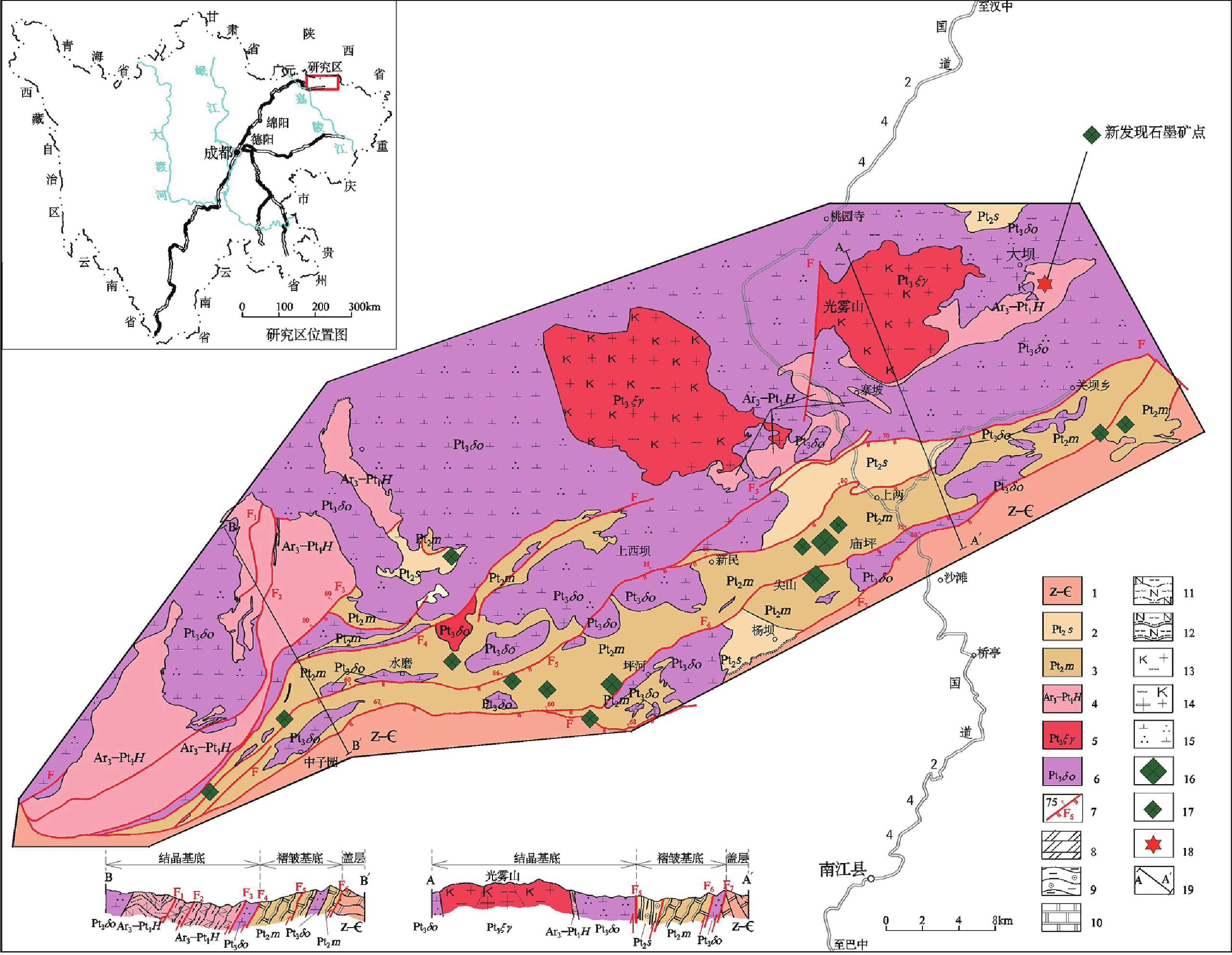
川北南江地区出露的前震旦系的变质岩系遭受了多期变形变质及岩浆活动的影响。根据其原岩建造、变质作用类型、构造变形样式及同位素年代学等特征,前人将其划分为结晶基底和褶皱基底(何政伟等,1997;刘援朝等,1997)。川北南江地区出露的结晶基底主要为后河岩群汪家坪岩组,褶皱基底为火地垭群上两组、麻窝子组(图1)。汪家坪组地层以灰色条纹状—条带状黑云斜长变粒岩、含石榴黑云斜长变粒岩、二云斜长变粒岩为主。上两组以片岩、千枚岩为主,中部含斑点状石榴石红柱石片岩、绿泥石片岩等。麻窝子组主要为大理岩与片岩、千枚岩组合,中部以大理岩为主,为区内石墨矿的主要产出层位。本次工作在南江大坝工作区的后河岩群汪家坪岩组中发现细粒石英岩,并在其中发现了晶质石墨矿。
|
图 1 上扬子北缘川北地区基底结构及新发现石墨矿位置图 (综合1∶200 000、1∶50 000区调及本次矿调工作修编)基底具双层结构:上层褶皱基底,为火地垭群变质岩,包括上两组、麻窝子组。岩石变质程度低,多为低绿片岩相−绿片岩相。主要岩石为板岩、千枚岩、片岩和大理岩或浅变质灰岩(白云岩),原岩为沉积岩。下层结晶基底,为后河岩群。岩石强烈变形变质,达麻粒岩相−角闪岩相。主要岩石为变粒岩、石英岩、片麻岩、片麻状花岗岩及角闪片岩等,原岩为火成岩、部分为沉积岩。由于后期构造岩浆活动,结晶基底被断层推覆于褶皱基底之上,而褶皱基底有时又叠置于盖层之上。1—震旦系−寒武系;2—中元古界上两组;3—中元古界麻窝子组;4—新太古界后河岩群;5—新元古界钾长花岗岩;6—新元古界石英闪长岩;7—断层及产状;8—白云岩;9—含石榴黑云片岩;10—大理岩;11—黑云斜长变粒岩;12—(凝灰)黑云斜长片麻岩;13—钾长花岗岩;14—似斑状钾长花岗岩;15—石英闪长岩;16—大型石墨矿床;17—石墨矿(点);18—新发现石墨矿点;19—图切剖面位置 |
含矿岩系主要为深灰色—灰黑色变质石英岩,出露宽度约300米,发育南东方向、南西方向两组节理,南东方向节理面上见石墨矿化。石墨矿化体出露宽度6.70米,走向200米,平均厚度4.9米,平均品位4.6%。赋矿岩石为细粒石英岩,岩石呈块状,主要成分为石英,次见石墨、云母、黄铁矿、赤铁矿。
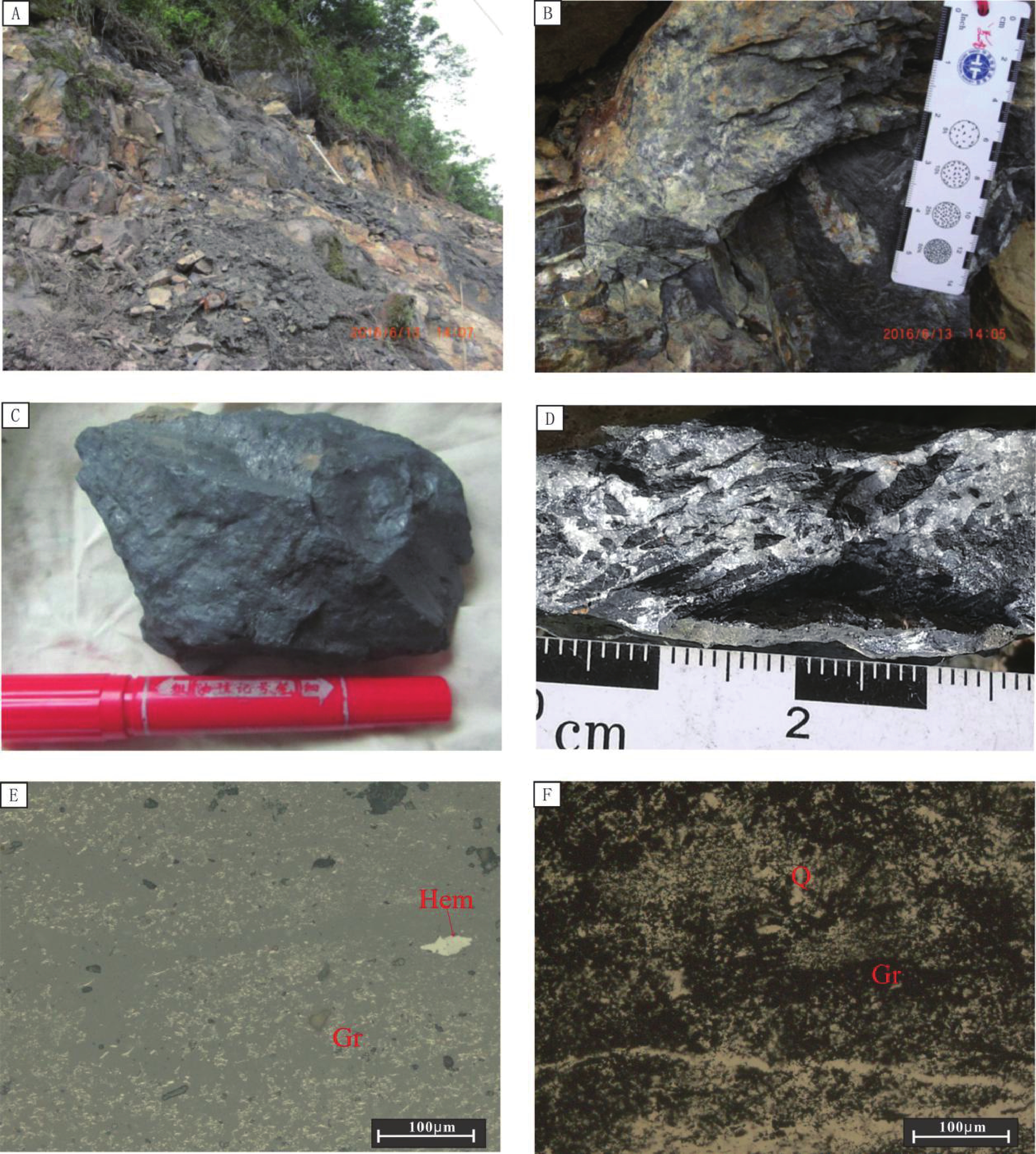
石墨矿主要表现为块状、条带状、角砾状三种构造特征(图2A、C、D)。块状石墨矿(图2A):风化面呈深灰色,具褐铁矿化,新鲜面为黑色,细粒变晶结构,块状构造。条带状石墨矿(图2C):呈黑色,与白色石英条带相间产出,两者宽度大致相当,约2~3 mm,延伸不稳定。角砾状石墨矿(图2D):该类型较少,为含硅质的热液沿裂隙构造裂隙贯入时形成的角砾岩;角砾成分为含石墨大理岩,角砾多呈次棱角状,胶结物为石英,呈基底式胶结,厚度约8 cm。
|
图 2 后河岩群汪家坪组石墨矿矿化特征 A–石墨矿露头;B–石英细脉;C–块状石墨矿石;D–角砾状石墨矿石;E–矿石光片(Gr石墨,Hem赤铁矿);F–矿石薄片(Gr石墨,Q石英) |
上扬子北缘川北地区结晶基底晶质石墨矿数据集的元数据简表见表1。

|
表 1 数据库(集)元数据简表 |
在地质填图过程中,巧遇高压输电线施工形成的“探槽”,进行观察发现石墨矿,并对其进行采样,共采集样品7个,样品特征见表2。现场根据石墨矿化强弱、岩石破碎程度,以及热液活动特征进行分段布样。共控制石墨矿化宽度6.70米,走向追索200米后为土掩盖。赋矿岩石为细粒石英岩,主要成份为石英,次见石墨、云母、黄铁矿、赤铁矿。岩石局部强劈理化,石英细脉发育,石墨含量相对较高(如图2A、2B)。
|
|
表 2 样品特征表 |
样品委托测试单位为西南冶金地质测试中心,其固定碳测试仪器设备为管式燃烧炉;测试依据按DZG20-02-1991《岩石矿物分析》;氧化物测试仪器设备为:Vista-MPX等离子光谱仪、DY938 X射线光谱仪、管式燃烧炉、CP124S电子天平2、Z-2000原子吸收分光度计、滴定管等。
试样中固定碳以非水滴定法进行测定,方法编号为DZG-02-1991。试样经硝酸和高温处理,除去碳酸盐和有机碳,然后在氧气流中经高温灼烧,产生的二氧化碳被吸收液吸收,用百里酚酞做指示剂,以乙醇钾标准溶液滴定得固定碳量。
3 数据样本描述上扬子北缘川北地区结晶基底晶质石墨矿数据集主要包括以下几个方面:结晶基底和褶皱基底展布、主要石墨矿床(点)分布、本次采样点位置、上扬子北缘川北地区结晶基底晶质石墨矿TC51固定碳分析结果表、上扬子北缘川北地区结晶基底晶质石墨矿TC51氧化物分析结果表。
“上扬子北缘川北地区结晶基底晶质石墨矿TC51固定碳分析结果表”(表3)包含如下内容:样号、分析号、样长(m)、固定碳含量(%)。
|
|
表 3 TC51固定碳分析结果表 |
“上扬子北缘川北地区结晶基底晶质石墨矿TC51氧化物分析结果表”(表4)包含如下内容:样号、分析号、样长(m)、测试项目19项包括SiO2、Al2O3、Fe2O3、TFe、FeO、CaO、MgO、K2O、Na2O、TiO2、P2O5、S、H2O+、H2O−、V2O5、CO2、Cu、灰份、挥发份等。
|
|
表 4 TC51氧化物分析结果表 |
项目工作按中国地质调查局2015年8月发布的《1∶50 000矿产地质调查工作指南》实施,野外定位采样数字地质调查系统(DGSS)进行定位。对发现的矿化点进行了探槽编录和刻槽采样。采集的样品全部送西南冶金地质测试中心进行加工、分析,内部检查样全部合格。由于石墨矿总体样品较少,没有抽送外检。
5 数据价值本数据为首次在上扬子陆块北缘结晶基底后河岩群汪家坪岩组石英岩中发现的晶质石墨矿的原始数据。该数据丰富了石墨矿成矿类型、拓展了石墨矿成矿时代,为石墨矿的理论研究提供了新的数据样本。同时,新发现的含矿地层在上扬子北缘及周缘分布广泛,该数据为片区石墨矿的找矿提供了新的方向和部署思路,为通南巴地区进一步找矿突破和全面脱贫攻坚提供了有力支撑。
6 结论1. 通过路线追索、实测剖面、刻槽取样、岩矿测试等对大坝石墨矿特征进行了具体调查分析,发现大坝石墨矿化特征较好。矿体延伸200米,出露宽度6.70米,宽体平均厚度4.90米,平均品位5.13%。根据区内坪河石墨矿建立的典型矿床模型,采用地质体积法对大坝石墨矿进行了资源潜力预测,在12平方千米范围内获得预测资源量173.80万吨。
2. 大坝后河岩群汪家坪岩组石墨矿的发现,是该区域初次在结晶基底中发现石墨矿,为川北地区,甚至整个上扬子北缘地区的石墨矿找矿工作带来新的思路和找矿方向。
3. 四川巴中超大型晶质石墨矿基地是《全国矿产资源规划(2016—2020)》确定的6大石墨矿资源基底之一。目前巴中市政府正大力推进工作的建设,新类型石墨矿的发现为此提供新的资源潜力。
4. 项目工作开展后,在巴中市政府引进下,社会资本在成矿带上开展石墨矿的找矿工作积极向好,为通江—南江—巴中贫困区带来了就业改善和地区经济进一步发展,为老区精准脱贫提供了助力。
致谢:本数据集是中国地质调查局地质调查项目“龙门山—滇中成矿带通安—宁蒗地区地质矿产调查”下设的子项目“四川南江地区矿产地质调查”的集体发现成果。其中,邹光富、廖均参与了前期的地质填图工作并发现了该石墨矿点,何龙、陈卓、潘伟奇参与了后期工程编录及采样工作。中国地质调查局成都地质调查中心王立全、王保弟,中国地质科学院矿产资源研究所肖克炎、孙莉等对工作提供了指导。在此一并致谢。
1 IntroductionIn China, regional metamorphic graphite deposits are mainly distributed on the periphery of ancient platforms and blocks, for instance, those found at Xinghe, Inner Mongolia, Nashu, Shandong, and Beizishi, Lushan County, Henan, on the northern, eastern and southern margins of the North China Platform, respectively; and Zhongba, Panzhihua, Sichuan, and Sanchaya, Yichang, Hubei, on the western and northern margins of the Yangtze Platform (Li C et al., 2015). In the north of China, graphite deposits mostly occur in crystalline basements (Liu JZ et al., 1989; Mo RJ et al., 1989; Li HB and Zhang B, 2014; Li C et al., 2015; Liu JD and Xiao RG, 2015; Sun HJ et al., 1995; Yang PQ et al., 2017), and less so in epimetamorphic rock series. In south China, graphite deposits found on the Yangtze Platform mainly occur in fold basements (Gao XZ, 2015; Wang HJ et al., 2017; Xia JS et al., 2017a, b; Ma CF et al., 2018; Ma ZX et al., 2018), for instance those at: Zhongba in the Yanbian Group complex, Panzhihua, Sichuan; Qujie in the Julin Group complex, Mouding, Yunnan; and Jianshan, Pinghe and Miaoping in the Huodiya Group complex, Nanjiang, Sichuan. Graphite deposits mainly are generated from regional and structural metamorphism whereas carbon comes from organic matter (Ma ZX et al., 2018). “Crystalline basement crystalline graphite deposit in the north margin of upper Yangtze” is the outcome of the sub-project “Guanba-Nanjiang geological survey in Nanjiang, Sichuang” under the China Geological Survey (CGS) geological survey project “Tongan–Ninglang Geological Mineral Survey in Longmen Mountain–Central Yunnan Metallogenic Zone” undertaken by the CGS Chengdu Geological Survey Center. The project completed 1:50 000 mineral-survey geological mapping, stream sediment measurements and remote-sensing geological interpretation, at 840 km2 each (2 map sheets: Guanba and Nanjiang) and examined mineral points discovered or delineated, such as Laiyiliang, Daba, Xinli, Xiongjiawan and Yuquan, or anomalies therein. Through the mineral geological survey done in Nanjiang, in north Sichuan, the project discovered crystalline graphite deposits in the Houhe Group complex of the crystalline basement.
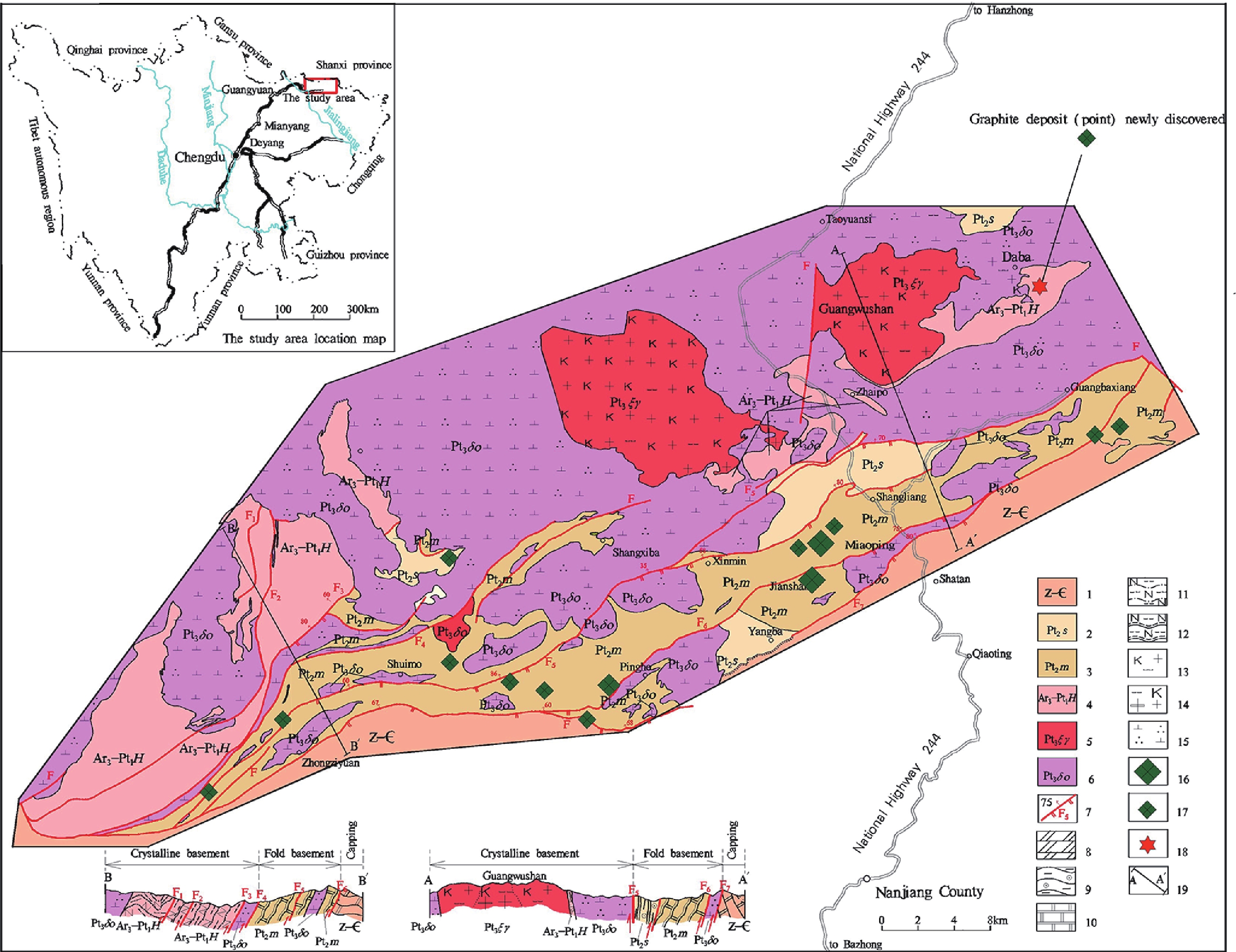
The metamorphic rock series of the pre-Sinian system to which outcrops in Nanjiang, north Sichuan, belong, has been affected by multiple periods of deformation, metamorphism and magmatism. Based on its characteristics, such as its protolith formation, metamorphic type, tectonic deformation pattern and isotope chronology, it has been divided into crystalline basement and fold basement (He ZW et al., 1997; Liu YC et al., 1997). The crystalline basement that outcrops in Nanjiang, Sichuan, is mainly the Houhe Group-complex Wangjiaping Formation and the fold basements are the Shangliang Formation and Mawozi Formation of the Huodiya Group-complex (Fig. 1). Strata in the Wangjiaping Formation are mainly gray streaky-banded biotite plagioclase granulite, garnet-bearing biotite, plagioclase granulite and two-mica plagioclase granulite. The Shangliang Formation mainly contains schist and phyllite, and its central part contains mottled garnet andalusite schist, etc. The Mawozi Formation mainly contains marble combined with schist and phyllite and its central part contains mainly marble, which is a main horizon of graphite ore in the area. In the Houhe Group-complex Wangjiaping Formation of the Nanjiang Dam work area, the project found fine-grain quartzite in which crystalline graphite ore was discovered.
|
图 1 Basement structure on the northern margin of the Upper Yangtze and northern Sichuan as well as location of newly discovered graphite deposit (1:200 000 and 1:50 000 regional survey and this mineral survey are combined)Basement is structured in two layers: the upper layer is fold basement, the Huodiya Group-complex metamorphic rocks, consisting of the Shangliang Formation and the Mawozi Formation. The rock is low in metamorphic grade, and mostly low green-schist facies ~ green-schist facies. It mainly contains slate, phyllite, schist and marble or epimetamorphic limestone (dolomite), and its protolith is sedimentary rock. The lower layer is crystalline basement of the Houhe Group complex. The rock is strongly deformed and metamorphic, of granulite facies ~ amphibolite facies. It mainly contains granulite, quartzite, gneiss, gneissoid granite and amphibolite schist etc., and its protolith is igneous rock, and partly sedimentary rock. Due to late structural magmatism, the crystalline basement is pushed over the fold basement by faults, and sometimes the fold basement overlies the capping.1−Sinian system-Cambrian system; 2−Mid-Proterozoic-erathem Shangliang formation; 3−Mid-Proterozoic-erathem Mawozi formation; 4−Neo-Archaeozoic-erathem Houhe group complex;5−Neo-Proterozoic-erathem moyite; 6−Neo-Proterozoic-erathem quartz diorite; 7−Fault and altitude; 8−Dolomite; 9−Garnet-bearing biotite schist; 10−Marble; 11−Biotite plagioclase granulite; 12−(Tuff) biotite plagioclase schist; 13−Moyite; 14−Porphyritic moyite; 15−Quartz diorite; 16−Large graphite deposit; 17−Graphite ore (point);18−Newly discovered graphite ore point; 19− Graph-cut profile location |
The ore-bearing series is mainly dark-gray to gray-black metamorphic quartzite, with about 300 m wide outcrops. It has two developed groups with joints in SE and SW directions, respectively, and graphite mineralization is seen on the SE joint surface. The graphite mineralized body is 6.70 m wide for its outcrop, 200 m long in strike, 4.9 m in average thickness and 4.6% in average grade. The host rock is fined-grain quartzite, which is in block form, and contains mainly quartz, and then graphite, mica, pyrite and hematite.
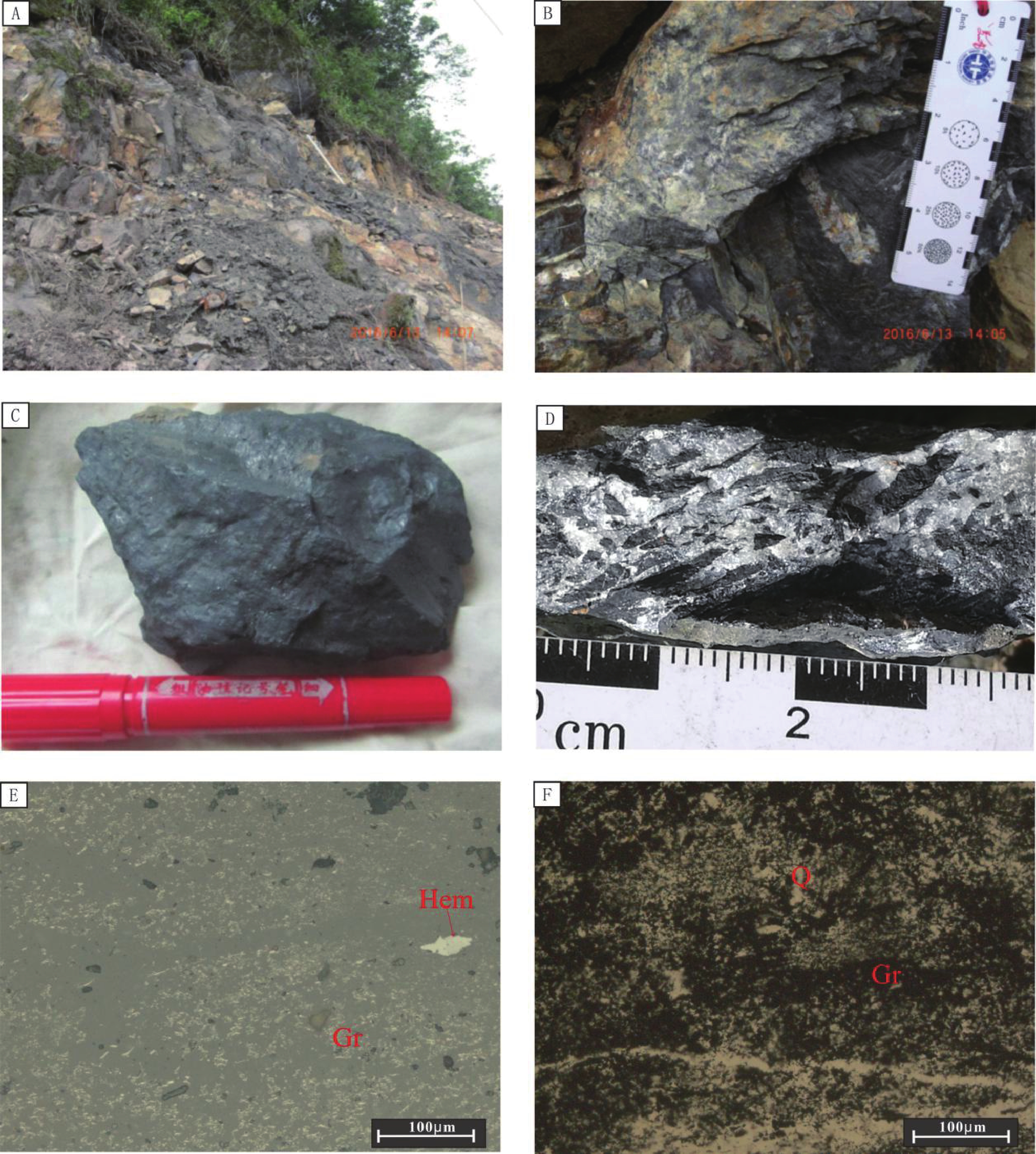
The graphite deposits have three structural features: blocky, banded and brecciated (Fig. 2A, C and D). The block graphite deposit (Fig. 2A) is dark-gray on its weathered surface, limonite-mineralized, black on the fresh surface, with fine-grain ferritization, and blocky structure. The banded graphite deposit (Fig. 2C) is black, occurring alternated with white quartz strips, both are about 2~3 mm wide, with unstable extensions. The brecciated graphite deposit (Fig. 2D) is a lesser type, breccia that is generated when siliceous hydrothermal solution flows in the fissures of fractures; it contains graphite-bearing marble, with breccia mostly subangular, and quartz is cemented in the basement. It is about 8 cm thick.
|
图 2 Mineralization features of the Houhe Group-complex Wangjiaping Formation graphite deposit A−outcrops of graphite deposit; B−quartz stringer; C−blocky graphite ore; D−brecciated graphite ore; E−polished ore section (Gr: graphite; Hem: hematite); F−thin ore section (Gr: graphite; Q: quartz) |
Metadata in the crystalline-basement crystalline graphite deposit dataset from the northern margin of the upper Yangtze and North Sichuan are shown briefly in Table 1.
|
|
表 1 Metadata Table of Database (Dataset) |
In the process of geological mapping, graphite ore was found in a chance encounter in an “exploratory trench” excavated during the erection of HV transmission cables at Daba. Seven samples were taken there, and sample features are shown in Table 2. Samples are laid out in sections on the basis of mineralization strength of the graphite, rock fragmentation and features of hydrothermal solution activity. Total graphite mineralization is controlled in a width of 6.70 m and it extends over 200 m along the strike before it is covered by soil. The host rock is fine-grained quartzite which contains mainly quartz, and then graphite, mica, pyrite and hematite. The rock has strong cleavage in localized places, quartz stringers are developed and then the graphite content is much higher (see Fig. 2A and B).
|
|
表 2 Sample features |
Samples were tested by Southwest Metallurgic Geological Test Center, and fixed carbon was tested in a tubular burner; tests were in accordance with DZG 20-02-1991 Rock and Ore Analysis. Oxides were tested using a plasma spectrometer Vista-MPX, X-ray spectrometer DY938, tubular burner, electronic balance CP124S, Atomic absorption spectral-photometer Z-2000 and burette, etc.
In test samples, fixed carbon was determined with non-aqueous titration DZG-02-1991. Test samples were treated with nitric acid at high temperature to remove carbonate and organic carbon, then burned at high temperature in oxygen flow; the generated CO2 was absorbed by an absorption solution, and the fixed carbon content was determined using thymolphthalein as indicator and titrating with potassium ethylate standard solution.
3 Description of Data SamplesThe Crystalline-Basement Crystalline Graphite Deposit Dataset on the Northern Margin of the Upper Yangtze and North Sichuan comprises mainly: crystalline basement and fold basement distribution, distribution of main graphite deposits (ore points), sampling locations, TC51 fixed carbon analysis result sheet of crystalline basement graphite deposit on the northern margin of the upper Yangtze, and TC51 oxide analysis result sheet of the same location.
The “TC51 fixed carbon analysis result sheet of crystalline basement graphite deposit on the northern margin of upper Yangtze” (Table 3) contains: sample number, analysis number, sample length (m) and fixed carbon content (%).
|
|
表 3 TC51 fixed carbon analysis result sheet |
The “TC51 oxide analysis result sheet of crystalline basement graphite deposit on the northern margin of upper Yangtze” (Table 4) contains: sample number, analysis number, length (m) and 19 test items including SiO2, Al2O3, Fe2O3, TFe, FeO, CaO, MgO, K2O, Na2O, TiO2, P2O5, S, H2O+, H2O−, V2O5, CO2, Cu, ash and volatiles, etc.
|
|
表 4 TC51 oxide analysis result sheet |
The project has been implemented in accordance with the Guidance to 1∶
This dataset contains the original data of the crystalline graphite deposits discovered in the Houhe Group-complex Wangjiaping Formation quartzite in the crystalline basement on the northern margin of the upper Yangtze landmass for the first time. It enriches the metallogenic types of graphite deposits, extends the era of graphite metallogenesis and provides a new data specimen for theoretical research concerning graphite deposits. Meanwhile, since newly discovered ore-bearing strata are widely distributed on the northern margin and periphery of the upper Yangtze, this dataset opens up new orientation and deployment thinking for graphite prospecting in the area and provides powerful support to further breakthroughs in prospecting and full poverty alleviation in Tongjiang, Nanjiang and Bazhong.
6 Conclusions1. Through route tracing, profile measurement, grooving and sampling, and rock ore testing, the Daba graphite deposit was surveyed in detail and good mineralization features were found. The mineral body extends 200 m, is 6.70 m wide in outcrop, 4.9 m in average thickness and 5.13% in average grade. Based on the typical deposit model built on the Pinghe graphite deposit in the area, the resource potential of the Daba graphite deposit is predicted using the geological volumetric method with a predicted resource of 1 738 000 tons within 12 km2 around it.
2. The Daba Houhe Group-complex Wangjiaping Formation graphite is the first graphite deposit discovered in the crystalline basement in the area, which brings new thinking and prospecting orientation to graphite prospecting in north Sichuan, even for the whole northern margin of the upper Yangtze.
3. The extra-large crystalline graphite base in Bazhong, Sichuan, is one of six main graphite resource bases determined in national Mineral Resource Planning (2016—2020). At present, the Bazhong government is making great efforts to build it, and discovery of new types of graphite deposits brings new resource potential for this.
4. After the project, under the guidance of the Bazhong government, social capital is active and optimistic in prospecting for graphite in the metallogenic zone, which is contributing to further employment and economic growth in the poverty area of Tongjiang–Nanjiang–Bazhong, and to precision poverty alleviation in the old revolutionary base areas.
Acknowledgements: This dataset is an achievement collectively made by the sub-project “Mineral Geological Survey in Nanjiang, Sichuan” under CGS project “Geological Mineral Survey in Tongan–Ninglang, Longmen Mountain–Central Yunnan Metallogenic Zone. Zou Guangfu and Liao Jun participated in previous geological mapping and found the graphite deposit, and He Long, Chen Zhuo and Pan Weiqi were involved in later project compilation, recording and sampling. Wang Liquan and Wang Baodi at CGS Chengdu Geological Survey Center, and Xiao Keyan and Sun Li, etc., at the Mineral Resource Institute of the Chinese Academy of Geological Sciences provided guidance to the project work. Hereby we thank all of them.
高显忠. 2015. 南江县尖山石墨矿地质特征及成因浅析[A]. 四川省地质学会2015年资料汇编I[C]. 四川省地质学会: 4.
|
何政伟, 刘援朝, 魏显贵, 肖渊甫, 马润则, 吴德超. 1997. 扬子克拉通北缘米仓山地区基底变质岩系同位素地质年代学[J]. 矿物岩石, 17(S1): 83-87. |
李超, 王登红, 赵鸿, 裴浩翔, 李欣尉, 周利敏, 杜安道, 屈文俊. 2015. 中国石墨矿床成矿规律概要[J]. 矿床地质, 34(6): 1223-1236. |
李寒滨, 张冰. 2014. 黑龙江云山石墨矿床变质作用及其意义[J]. 中国非金属矿工业导刊, 33(1): 45-46. DOI:10.3969/j.issn.1007-9386.2014.01.016 |
刘金中, 钱祥麟, 陈亚平. 1989. 中国内蒙中部孔兹岩系中石墨矿的构造成因[J]. 大地构造与成矿学, 13(2): 67-72. |
刘敬党, 肖荣阁. 2015. 华北晶质石墨矿床[M]. 北京: 科学出版社, 1−675.
|
刘援朝, 魏显贵, 吴德超. 1997. 扬子地台北缘早前寒武纪结晶基底构造样式及变形特征[J]. 矿物岩石, 17(S1): 88-96. |
马彩凤, 彭同江, 孙红娟, 梁小毅, 张冬. 2018. 四川南江坪河石墨的矿物学特征[J]. 矿物学报, 38(3): 257-262. |
马志鑫, 罗茂金, 刘喜停, 孙志明. 2018. 四川南江坪河石墨矿炭质来源及成矿机制[J]. 地质科技情报, 37(3): 134-139. |
莫如爵, 刘绍斌, 黄翠蓉, 张光荣, 谭冠民, 王宝娴, 肖祥章. 1989. 中国石墨矿床地质[M]. 北京: 中国建筑工业出版社, 65− 80.
|
孙厚江, 吴春林, 曲廷耀. 1995. 辽河群孔达岩系与石墨矿床[J]. 矿产与地质, 9(3): 208-212. |
王红军, 侯学文, 岑海涛, 魏继生. 2017. 四川省南江县庙坪石墨矿成矿地质特征及成因探讨[J]. 科技创新导报, 14(6): 45-46, 48. |
夏锦胜, 孙莉, 肖克炎, 朱裕生. 2017. 四川省南江县坪河石墨矿床地质特征及成因分析[J]. 现代矿业, 33(2): 57-59, 77. DOI:10.3969/j.issn.1674-6082.2017.02.015 |
夏锦胜, 孙莉, 肖克炎. 2017. 四川南江尖山石墨矿床地质特征及成因[J]. 地质学刊, 41(2): 212-217. DOI:10.3969/j.issn.1674-3636.2017.02.007 |
杨培奇, 刘敬党, 张艳飞. 2017. 黑龙江佳木斯地块典型石墨矿床含矿岩石地球化学特征及成矿时代[J]. 中国地质, 44(2): 301-315. |
Gao Xianzhong. 2015. Analysis on geological characteristics and genesis of jianshan graphite mine in nanjiang county [A]. Archives compiled by Sichuan geological society in 2015 I [C]. Geological Society of Sichuan Province: 4 (in Chinese).
|
He Zhengwei, Liu Yuanchao, Wei Xiangui, Xiao Yuanfu, Ma Runze, Wu Dechao. 1997. Isotopic geochronology of basement metamorphic rock series in the micangshan area along the northern margin of Yangtze craton. China[J]. Journal of Mineralogy and Petrology, 17(S1): 83-87. |
Li Chao, Wang Denghong, Zhao Hong, Pei Haoxiang, Li Xinwei, Zhou Limin, Du Andao, Qu Wenjun. 2015. Minerogenetic regularity of graphite deposits in China[J]. Mineral Deposits, 34(6): 1223-1236. |
Li Hanbin, Zhang Bing. 2014. Metamorphism and Its Significance of Yunshan Graphite Deposit in Heilongjiang[J]. China Non-Metallic Minerals Industry, 33(1): 45-46. |
Liu Jinzhong, Qian Xianglin, Chen Yaping. 1989. The tect onic origin of graphite deposits in the khondalite group, the middle part of inner mongolia, China[J]. Geotectonica Et Metallogenia, 13(2): 67-72. |
Liu Jingdang, Xiao Rongge.2015. The crystalline graphite deposit in north China[M].Beijing, Science Press, 324−328 (in Chinese).
|
Liu Yuanchao, Wei Xiangui, Wu Dechao. 1997. Structure styles and characteristics in early precambrian crystalline basement in the northern margn of Yangtze platform[J]. Journal of Mineralogy and Petrology, 17(S1): 88-96. |
Ma Caifeng, Peng Tongjiang, Sun Hongjuan, Liang Xiaoyi, Zhang Dong. 2018. A Study on Mineralogical Characteristics of Pinghe Graphite Deposit in Nanjiang County, Sichuan Province, China[J]. Acta Mineralogica Sinica, 38(3): 257-262. |
Ma Zhixin, Luo Maojin, Liu Xiting, Sun Zhiming. 2018. Carbon Source and Metallogenic Mechanism of Pinghe Graphite Deposit at Nanjiang, Sichuan Province[J]. Geological Science and Technology Information, 37(3): 134-139. |
Mo Rujue, Liu Shaobin, Huang Cuirong, Zhang Guangrong, Tan Guanmin, Wang Baoxian, Xiao Xiangzhang. 1989. Geology of graphite deposits in China [M]. Beijing: China Architecture & Building Press, 65−80 (in Chinese).
|
Sun Houjiang, Wu Chunlin, Qu Tingyao. 1995. Graphite deposit and Kongda rock sekies in liaoning group[J]. Mineral sources and geology, 9(3): 208-212. |
Wang Hongjun, Hou Xuewen, Cen Haitao, Wei Jisheng. 2017. Discussion on metallogenic geological characteristics and genesis of Miaoping graphite deposit in Nanjiang county, Sichuan province[J]. Science and Technology Innovation Herald, 14(06): 45-46,48. |
Xia Jinsheng, Sun Li, Xiao Keyan, Zhu Yusheng. 2017. Geological characteristics and genetic analysis of graphite deposits in Pinghe, Nanjiang County, Sichuan Province[J]. Modern Mining, 33(02): 57-59,77. |
Xia Jinsheng, Sun Li, Xiao Keyan. 2017. Geological characteristics and genesis of Jianshan graphite deposit in Nanjiang County, Sichuan Province[J]. Journal of Geology, 41(2): 212-217. |
Yang Peiqi, Liu Jingdang, Zhang Yanfei. 2017. Ore geochemical characteristics and metallogenic epoch of typical graphite deposits in Jiamusi Massif, Heilongjiang Province[J]. Geology in China, 44(2): 301-315. |