
 PDF
PDF


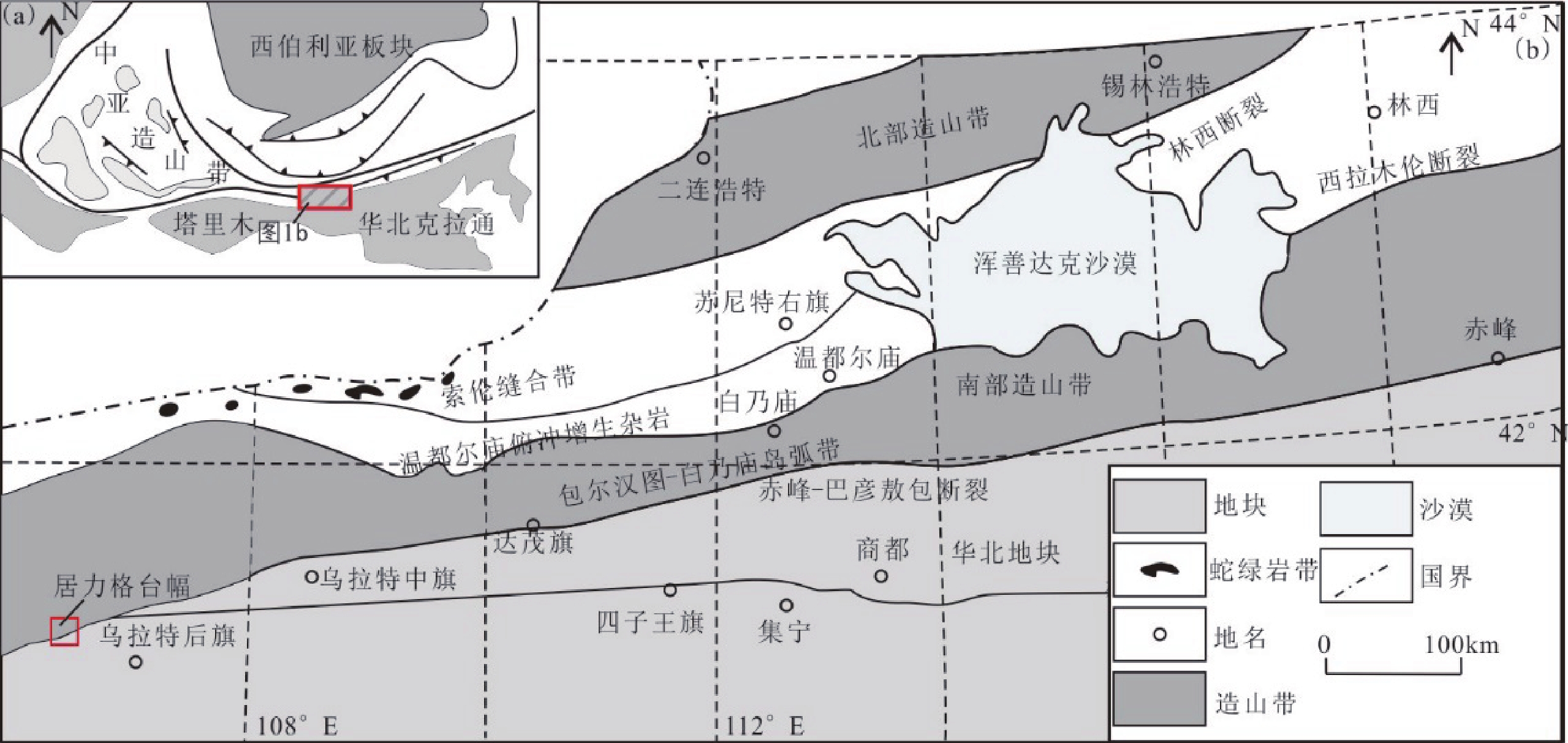
中亚造山带作为世界上最大的显生宙造山带,东西和南北延长达数千千米(图1a),其复杂的构造演化过程与古亚洲洋的构造运动密切相关(Windley BF et al., 2007; Han BF et al., 2011; Xu Z et al., 2012; Zhang XH et al., 2012; Xu B et al., 2013; Zhang W et al., 2013; 王树庆等,2019)。古亚洲洋盆的俯冲增生造山与地体拼贴过程造就了现有的构造格架(Coleman RG, 1989;Windley BF et al., 1990,2007; Allen MB et al., 1993, 1995; Sengor AMC et al., 1993; Gao J et al., 1998; Jahn BM et al., 2000; Xiao WJ et al., 2004, 2010; Li YJ et al., 2018, 2020; Yuan Y et al., 2018; Zheng RG et al., 2018; 赵磊等,2019;赵闯等,2020)。近些年围绕华北地块北缘古生代构造岩浆作用及前寒武纪地层划分等重要地质问题进行了大量科学研究,获得了丰富的资料(张维等,2012;Zhang W et al., 2013;吴飞等,2014;Wang ZZ et al., 2015; Liu M et al., 2016; 田健等2018;Wang XY et al., 2018;滕学建等,2019)。狼山地区位于华北地块北缘西部(图1a),北侧为中亚造山带,南侧为华北克拉通(Wu TR et al., 1998; 刘烨,2012;冯丽霞等,2013;Peng RM et al., 2013),其特殊的构造位置对于认识区域构造演化具有重要意义。
|
图 1 内蒙古狼山地区大地构造位置图(a)及居力格台幅位置示意(b)(据Wang ZZ et al.,2015修改) |
内蒙古居力格台幅位于狼山地区乌拉特后旗北西侧(图1b),区内出露地质体主要为元古宙变质沉积岩及古生代侵入岩,其中以晚古生代侵入岩的大面积发育为特征。内蒙古自治区第一区域地质调查队(1982)完成了1∶200 000区域地质矿产调查,对区内的地层格架、岩浆活动、构造演化及成矿地质背景等方面进行了全面系统的总结。然而,一些重要的地质问题,如华北地块北缘古生代构造体制转换、渣尔泰山群的形成时代及霍各乞大型铜矿的成矿地质背景等仍然需要进一步调查和研究,为此开展了内蒙古居力格台幅1∶50 000区域地质矿产调查,形成内蒙古居力格台幅1∶50 000地质图数据库(表1,刘洋等,2020)。

|
表 1 数据库(集)元数据简表 |
内蒙古居力格台幅1∶50 000地质图作为狼山地区造山带填图的探索性图件,力争在客观表达野外地质事实的基础上,结合前人地质调查、矿产勘查以及科研新成果,采用造山带填图思路,综合造山带构造解析手段(白瑾,2003),精细刻画狼山地区地质构造演化过程。
2 数据采集和处理方法 2.1 数据基础内蒙古居力格台幅1∶50 000地质图以《区域地质调查技术要求(1∶50 000)》(DD 2006-XX)为规范,根据项目野外实际资料(实际材料图、剖面图)重新连图而成,代表居力格台幅1∶50 000最新地质填图新成果。地理底图采用国家测绘地理信息局最新地理数据。应用已有的技术标准和数字填图系统(DGSS)、MapGIS等计算机软件进行数据处理。
2.2 数据处理过程数据处理过程是将收集到的区域地质调查成果和实际材料图进行数字化处理,形成MapGIS点、线、面文件,建立野外原始数据库。成果空间数据库是由野外原始数据库继承而来。
2.2.1 野外原始数据库根据已有资料的综合分析和地质草图的编制,划分重点工作区和一般工作区,确定了重点填图内容为渣尔泰山群及古生代岩浆岩。原始数据库整体又可分为数字填图资料和数字剖面库。
数字填图原始资料包含1∶25 000图幅PRB库、实际材料图库、原始资料备份、野外手图、背景图层、样品数据库等数字填图原始资料数据库各4个。其中野外手图库存储野外地质路线各类地质数据,是最重要的野外第一手原始资料数据库。单条野外手图路线库均由Images(存储照片)、Note(存储XML文档及TXT文本)、素描图(存储素描图)3个文件夹及9个野外路线实体观测数据点线采集层(表2)和ATTNOTE.WT(产状标注)、GPTNOTE.WT(地质点标注)2个标注图层以及野外设计地质路线(ROUTE.MPJ)和以路线编号为文件名(如L0001.MPJ)的2个工程文件及地理背景图层等组成。图幅PRB库文件类型及文件名与野外手图库完全一致。实际材料图库继承PRB库野外路线实体观测数据点、线采集层及标注图层,同时自动生成GEOLABEL.WT、GEOLINE.WL、GEOPOLY.WP点、线、面3个文件。背景图层存储地理底图数据,主要包括地理信息、水系、交通、居民地、境界、地形等要素。样品数据库存储图幅不同类型样品,分为样品采集库、送样库和测试鉴定成果库3类,数据存放在RgSample.MDB数据库中。
|
|
表 2 野外数据实体表 |
地质图空间数据库包括基本要素类、综合要素类、对象类和独立要素类数据集。其中要素数据集是共享空间参考系统的要素类的集合,在地质图数据模型中,由地质点、面、线实体类构成。对象类是一个表,存储非空间数据,在地质图数据模型中,一般1个要素类对应多个对象类。居里格台幅对应的要素类和对象类列于表3。
|
|
表 3 1∶50000居力格台幅地质图空间数据库要素类和对象类一览表 |
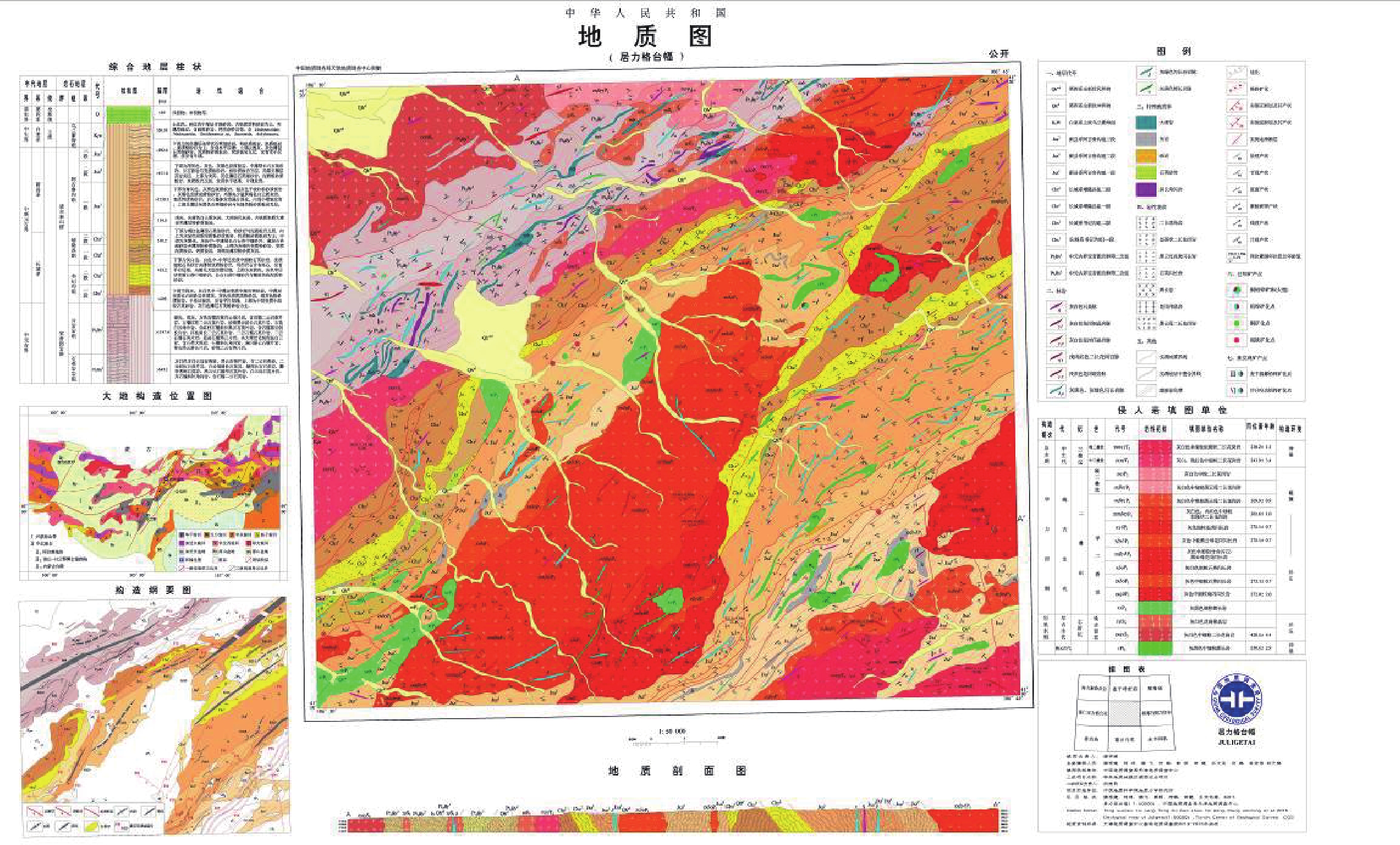
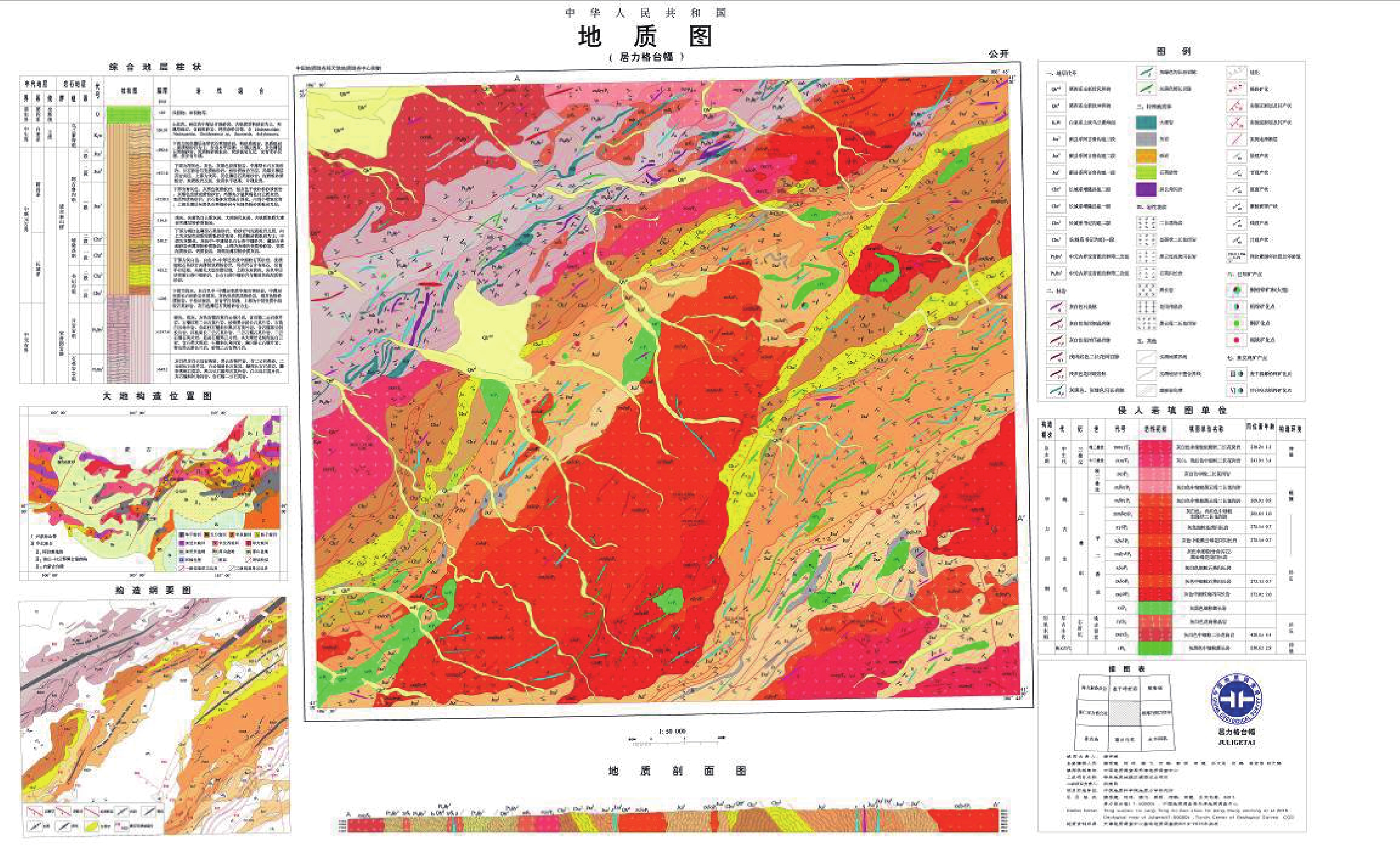
内蒙古居力格台幅 (K48E017019)1∶50 000地质图图外要素包括:综合柱状图、侵入岩填图单位、图切剖面、构造纲要图、所处大地构造位置图和其他图表(图2)。
|
图 2 内蒙古居力格台幅1∶50 000地质图示意图 |
(1)综合柱状图:对地层分区内的岩石地层单元沉积建造特征进行详细表达。系统梳理图幅内各地层单元地层层序、沉积建造特征,结合锆石测年资料,综合反映其沉积背景及时代属性。
(2)侵入岩填图单位:图幅内侵入岩填图单位包括晚元古代辉长岩,晚志留世侵入岩(主要岩性为中细粒二长花岗岩及花岗伟晶岩),早二叠世侵入岩(主要岩性为中粒辉长岩、细粒石英闪长岩、中细粒石英闪长岩、中粒黑云母花岗闪长岩、中细粒(含角闪石)黑云母花岗闪长岩、中粒二长花岗岩、中细粒似斑状二长花岗岩),中–晚三叠世酸性侵入岩 (主要岩性为中细粒二长花岗岩,中细粒似斑状二长花岗岩)。
(3)图切剖面:图幅内建造和构造的总体走向为北东向,为直观表达区内各地质体接触关系及空间位态,布置1条北西向贯穿全区的剖面,反映不同地质体之间的接触关系及渣尔泰山群中变质沉积岩的褶皱变形特征。
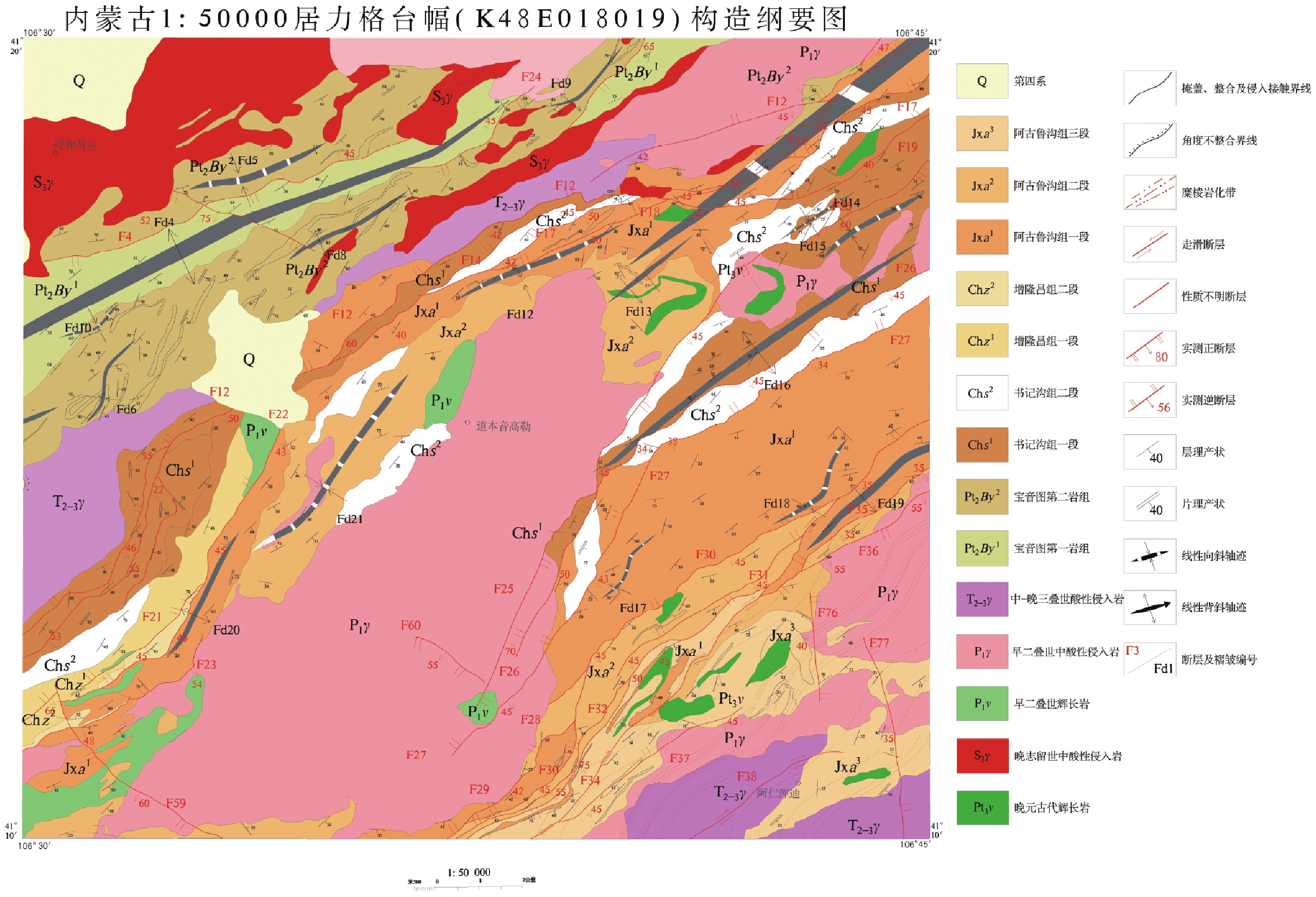
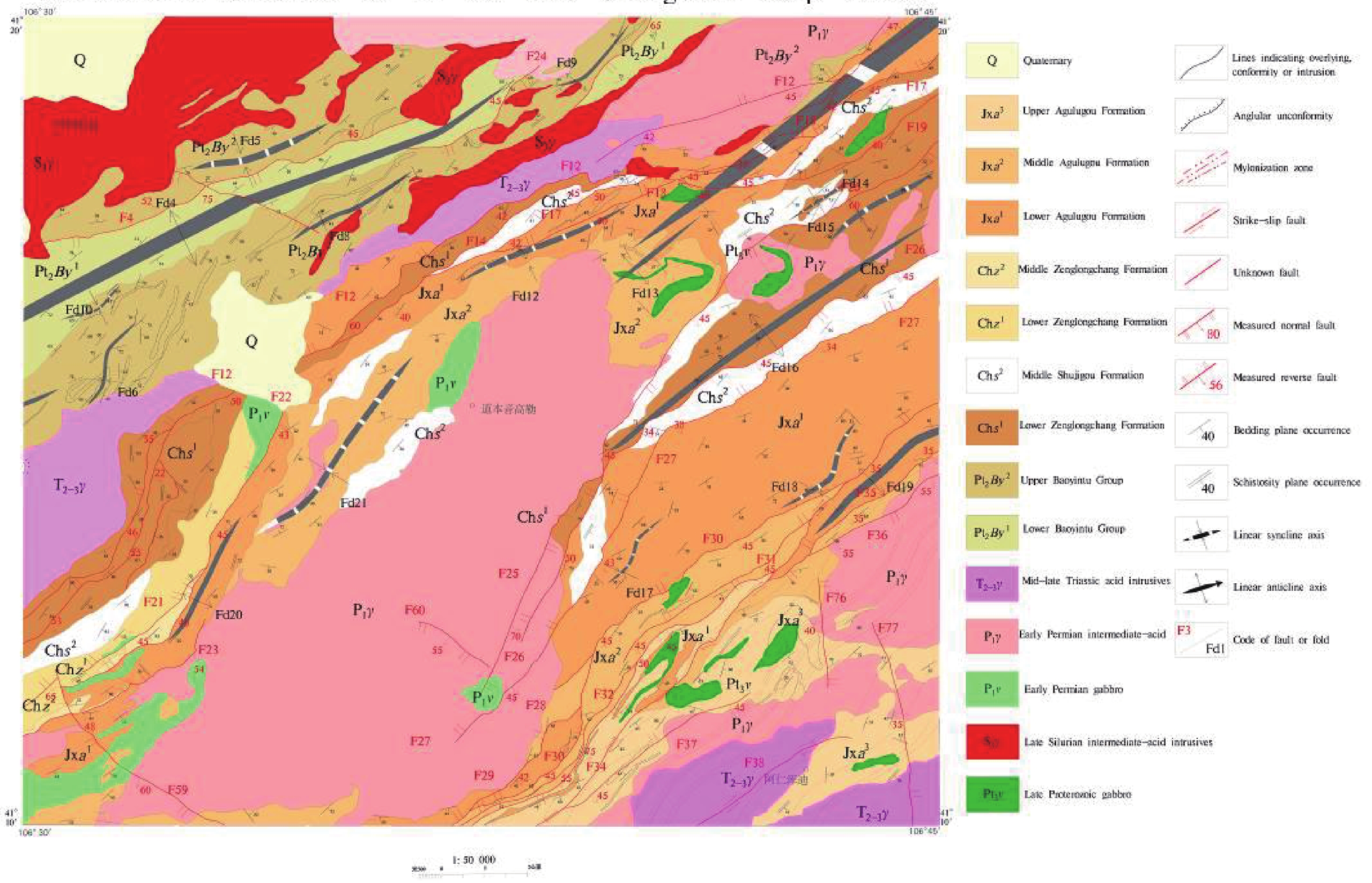
(4)构造纲要图:以板块构造理论为基础,采用构造—岩性填图方法、以不同规模相对稳定的古老陆块区和不同时期的造山系时空结构分析为主线,并以特定区域主要构造事件形成的沉积建造、岩浆活动、变形和变质作用等具体地质事件,充分体现本区的地质构造格架为原则,绘制构造纲要图(图3)。
|
图 3 内蒙古1∶50 000居力格台幅构造纲要图 |
(5)所处大地构造位置图:表达了居力格台幅在区域大地构造中所处的大地构造位置及大地构造单元划分情况。本图幅位于II级大地构造单元包尔汉图—赤峰陆缘活动带。
(6)其他图表:对脉岩、地质代号、地质符号及岩性花纹进行梳理,编制图例及责任表。
3 数据内容 3.1 数据命名地质面.WP,地质线.WL,地质点.WT。
3.2 图层内容主图内容包括第四系、沉积岩、火山岩、侵入岩、构造形迹、地质界线、产状、各类代号等。
图外要素内容包括接图表、地层综合柱状图、侵入岩填图单位、图切剖面、构造纲要图、大地构造位置图、图例、责任表等。
3.3 数据类型实体类型名称:点、线、面。
点实体:各类地质体符号及标记、地质花纹、矿化蚀变。
线实体:地质界线、岩相界线、断裂构造、构造界线等。
面实体:第四系、沉积岩、火山岩、变质岩、侵入岩等。
3.4 数据属性不同图幅由于地质内容有别,对应的地质图空间数据库要素类和对象类亦不尽相同。其中独立要素类属地质图廓外相关内容,不带属性。除上述各要素图层外,另有断层线、地质体面实体引线、地质体代号、岩性花纹、产状标注、同位素年龄值、图切剖面线及标注等没有属性内容的地质整饰图层。此外,尚有等高线、交通、居民地、境界等相关地理底图图层等。现将地质图基本要素类、综合要素类和对象类各数据项属性列表见表4。
|
|
表 4 内蒙古居力格台幅1∶50 000地质图空间数据库数据属性表 |
填图精度总体按照《区域地质调查技术要求(1∶50 000)》(DD2006—XX)标准进行野外填图。在实际填图过程中,对基岩区采取加密地质路线调查,对中—新生代地层区采取遥感解译为主、野外验证为辅的方式进行。
居力格台幅1∶50 000地质图数据库的野外实测入库路线154条,地质点数1094个,地质点间界线数2963个,基本分析样品449件,产状877个,素描134个,照片1990张,填图总体精度达到1∶50 000区域地质专项填图的具体要求。
数据质量方面,采用填图路线自检、互检达100%,项目组抽检30%,符合地质调查项目质量管理要求,图面拓扑无错误率、属性填写规范、填写率为90%以上,保证了数据库的质量。原始资料丰富、翔实,总体均完成或超额完成了项目各项工作量,在地层划分对比、侵入岩解体和年代学研究、构造地质等方面均取得明显进展。居力格台幅(K48E017019)野外验收专家组评定92.5分,成果验收专家组评定94分,为优秀级,居力格台幅参加全国区域地质调查优秀图幅展评(毛晓长,2018),在2018年中国地质调查局优秀图幅评选中被评为优秀图幅。
5 数据价值内蒙古居力格台幅(K48E017019)1∶50 000地质图对测区发育的侵入岩、渣尔泰山群及构造变形等进行了详细分析,获得的主要成果如下:
(1)查明了不同侵入体的岩石类型、相互间接触关系及与其与围岩的接触关系,初步探讨了侵入岩的演化规律和构造背景(表5)。根据构造岩浆期次将古生代以来的侵入岩划分为3期构造岩浆作用,第一期形成早古生代大陆边缘弧岩浆岩(花岗闪长岩–二长花岗岩(468 Ma)、石英闪长岩–花岗闪长岩–二长花岗岩(440~420 Ma))、第二期形成晚古生代俯冲–碰撞岩浆岩(辉长岩–闪长岩–石英闪长岩–花岗闪长岩–二长花岗岩(330~290 Ma)及二叠纪早–晚期辉长岩–闪长岩–石英闪长岩–花岗闪长岩–二长花岗岩(280~260 Ma)),第三期形成早中生代后造山岩浆岩带花岗闪长岩–二长花岗岩–正长花岗岩(260~230 Ma)。通过锆石Hf同位素手段对测区主要岩浆岩的物质来源及成因进行了初步研究,单颗粒锆石Lu–Hf测试分析表明,奥陶纪–志留纪的岩浆岩εHf(t) 表现为较大的负值,锆石Hf二阶模式年龄为古元古代(2077~1779 Ma),显示了早古生代晚期大陆边缘弧岩浆岩的源区可能为以宝音图岩群为主的基底;晚石炭世—三叠纪岩浆岩的源区εHf(t)变化较大,多为较小的正值,显示了以年轻地壳熔融为主的特点。
|
|
表 5 内蒙古居力格台幅侵入岩时间序列表 |
(2)对渣尔泰山群的书记沟组、增隆昌组和阿古鲁沟组进行了段级单位的划分。这套地层呈复式向斜产出,测得侵入阿古鲁沟组中的辉长岩年龄为850 Ma,结合碎屑锆石年龄特征,将该地层时代厘定为新元古代。
(3)查明测区经历了3期构造变形,第1期为发育在宝音图岩群中的早期顺层剪切褶皱变形−大理岩标志层的顺层掩卧褶皱和无根勾状褶皱,斜长角闪岩和石英岩发育的石香肠和不对称剪切褶皱;第2期变形发育在渣尔泰山群的透入性片理S1形成以及复向斜构造,还造成了宝音图岩群的片理褶皱和新生面理S2的形成和志留纪花岗岩的褶皱;第3期变形发育早二叠世大石寨组之后,表现为中浅部构造层次同斜倒转褶皱,造成了渣尔泰山群片理褶皱带的发育。
(4)明确霍各乞大型铜矿的赋矿围岩为阿古鲁沟组二段炭质–钙质板岩,矿床总体位于该地层的片理褶皱形成的转折端部位。
6 结论(1)内蒙古居力格台幅(K48E017019)1∶50 000地质图是中国地质调查局新一轮地质调查的探索性图幅,采用构造–岩性填图方式提升成果表达方式,对区域地质调查特别是造山带填图起到了示范作用。
(2)以中国地质调查局《数字地质图数据库标准》(DD2006−06)为标准,全面系统编制了居力格台幅(K48E017019)1∶50 000地质图并建立了空间数据库,详细表达了不同地质体的基本属性。
(3)通过野外沉积建造、构造变形序列研究,结合岩石地球化学及年代学测试资料,系统查明了中元古代宝音图岩群岩石组成、变形变质特征、原岩建造及中–新元古代渣尔泰山群的基本层序、沉积环境;明确了宝音图岩群经历了3期变形,表现为早期顺层剪切变形、片理褶皱及片理膝褶,渣尔泰山群经历了2期变形,表现为早期层理褶皱及晚期片理褶皱;梳理了古生代侵入岩演化序列为早古生代大陆边缘弧岩浆岩、晚古生代俯冲–碰撞岩浆岩,早–中生代后造山岩浆岩;认为霍各乞大型铜矿的成矿构造为阿古鲁沟组二段炭质–钙质板岩片理褶皱导致的转折端部位,这些资料可为后续基础地质调查与科学研究工作提供基础。
致谢:内蒙古居力格台幅1∶50 000地质图是一项集体成果,项目组一线地质工作人员付出了辛勤的努力。在地质图填绘及数据库的建立过程中,得到中国地质调查局天津地质调查中心赵风清研究员、王惠初研究员、辛后田教授级高级工程师及中国地质科学院地质力学所胡健民研究员的辛勤指导,在此对各位专家和野外项目组所有成员表示最诚挚的感谢。
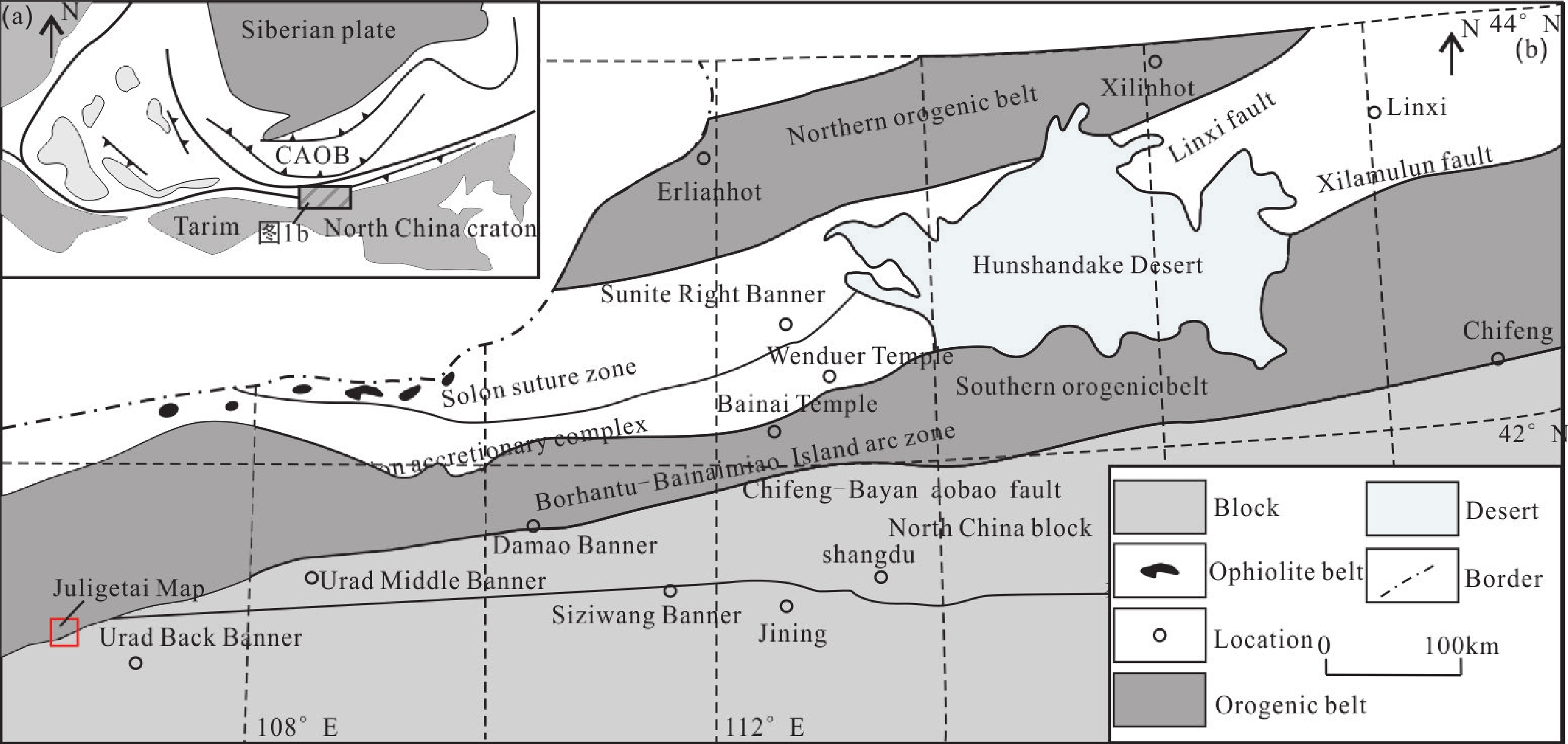
1 IntroductionAs the largest Phanerozoic orogenic belt in the world, the Central Asian Orogenic Belt (CAOB) extends for thousands of kilometers in all directions (Fig. 1a). Its complex tectonic evolution process is closely associated with the tectonic movement of the Paleo-Asian Ocean (Windley BF et al., 2007; Han BF et al., 2011; Xu Z et al., 2012; Zhang XH et al., 2012; Xu B et al., 2013; Zhang W et al., 2013; Wang SQ et al., 2019). The process of subduction, accretion, orogeny and terrane collage of the Paleo-Asian ocean basin resulted in the current tectonic framework (Coleman RG, 1989; Windley BF et al., 1990, 2007; Allen MB et al., 1993, 1995; Sengor AMC et al., 1993; Gao J et al., 1998; Jahn BM et al., 2000; Xiao WJ et al., 2004, 2010; Li YJ et al., 2018, 2020; Yuan Y et al., 2018; Zheng RG et al., 2018; Zhao L et al., 2019; Zhao C et al., 2020). In recent years, a large number of scientific studies have been conducted on important geological issues such as Paleozoic tectonic magmatism and Precambrian stratigraphic subdivision in the northern margin of the North China Block, obtaining rich data (Zhang W et al., 2012; Zhang W et al., 2013; Wu F et al., 2014; Wang ZZ et al., 2015; Liu M et al., 2016; Tian J et al. 2018; Wang XY et al., 2018; Teng XJ et al., 2019). Located in the west of the northern margin of the North China block (Fig. 1a), with the Central Asian Orogenic Belt in the north and the North China Craton in the south (Wu TR et al., 1998; Liu Y, 2012; Feng LX et al., 2013; Peng RM et al., 2013), the Langshan area is of great significance for understanding regional tectonic evolution due to its special tectonic location.
|
Fig. 1 Geotectonic location (a) of the Langshan area, Inner Mongolia, and location of the Juligetai map-sheet (b) (modified from Wang ZZ et al., 2015) |
The Juligetai Map-sheet, Inner Mongolia is located on the north–west side of the Wulatehou Banner in the Langshan area (Fig. 1b). The exposed geobodies in the area are primarily Proterozoic metamorphic sedimentary rocks and Paleozoic intrusive rocks, characterized by the development of Late-Paleozoic intrusive rocks in large areas. The First Regional Geological Survey Team of the Inner Mongolia Autonomous Region (1982)completed a 1∶200 000 Regional Geological and Mineral Survey, providing a comprehensive and systematic review of the stratigraphic framework, magmatism, tectonic evolution and metallogenic background in the area. However, important geological issues including the Paleozoic tectonic regime transformation in the northern margin of the North China block, formative era of the Zhaertaishan Group and metallogenic background of the Huogeqi Copper Deposit still need further investigation. In the current project, we conducted a 1∶50 000 Regional Geological and Mineral Survey in the Juligetai Map-sheet, Inner Mongolia, and established a corresponding 1∶50 000 Geological Map Database (Table 1, Liu Y et al., 2020).
|
|
Table 1 Metadata Table of Database (Dataset) |
The 1∶50 000 Geological Map of the Juligetai Map-sheet, Inner Mongolia represents a pilot project of orogenic belt mapping in the Langshan area. It aims to describe in detail the tectonic evolution in the Langshan area with objectively expressed field geological facts by incorporating previous geological surveys, mineral exploration and the latest research results, in addition to adopting advanced mapping approaches combined with tectonic analysis of the orogenic belt (Bai J, 2003).
2 Data Collection and Processing Methods 2.1 Data SourceIn line with the ‘Technical Requirement for Regional Geological Surveys (1∶50 000)’ (DD 2006-XX), the 1∶50 000 Geological Map of the Juligetai Map-sheet, Inner Mongolia was created according to actual field data (including actual material maps and profiles) as a new achievement of the 1∶50 000 geological mapping of the Juligetai map-sheet. The project adopted the latest geographic data from the National Geomatics Center of China (NGCC) for geological base maps and applied existing technical standards and computer software such as the Digital Geological Survey System (DGSS) and MapGIS for data processing.
2.2 Data ProcessingThe purpose of data processing is to digitize the collected regional geological survey results and actual material maps to form MapGIS point, line and area files; and to establish the original field database, as the spatial database originate from it.
2.2.1 Field Original DatabaseBased on the comprehensive analysis of the existing data and geological sketches, we established key working areas and general working areas, and identified the Zhaertaishan Group and Paleozoic magmatic rocks as the key contents of mapping. The original database as a whole can be divided into digital mapping data and a digital profile database.
The original data of the digital mapping includes 4 original databases of the 1∶25 000 map PRB database, actual material map database, original data backup, free hand field maps, background layers and sample database; of which the free hand field map database stores various data of geological field routes and represents the most important first-hand original database. A single field map route database is composed of Images (photos), Note (XML files and TXT text files), Sketch (sketches), 3 folders, 9 point and line acquisition layers of field route observation data (Table 2), ATTNOTE.WT (attitude note), GPTNOTE.WT (geological point note), 2 labeled layers and geological routes (ROUTE.MPJ), and 2 engineering documents and geographical background layers with the route number as the file name (e.g. L0001. MPJ).
|
|
Table 2 Field data entity table |
The file type and file name of the PRB library are completely consistent with that of the field map library. The actual material library inherits the point and line acquisition layers and labeled layers of the field route observation data of the PRB library, while automatically generating the 3 point, line and area files, i.e., of GEOLABEL.WT, GEOLINE.WL and GEOPOLY.WP. The background layer stores the data of the geographic base maps, including geographic information, water system, transportation, residential area, boundary and topography. The sample database stores different types of samples from the map-sheet and is divided into three categories: sample collection database, sample submission database, and test and identification result database, with the data being stored in the RgSample.MDB database.
2.2.2 Spatial DatabaseThe geological map spatial database includes the datasets of basic feature class, complex class, object class and independent feature class; of which the feature dataset is a collection of features sharing the same spatial reference system and is composed of geological point, area and line entities in the geological map data model. The object class is a table storing non-spatial data. In a geological map data model, 1 Feature type generally corresponds to multiple object classes. The feature class and object class of the Juligetai map-sheet are shown in Table 3.
|
|
Table 3 Feature and object class of 1∶50 000 geological map database of the Juligetai map-sheet |
The outer features of the 1∶50 000 geological map of the Juligetai map-sheet (K48E017019), Inner Mongolia include: columnar section, intrusive rock mapping unit, cutting profile, structural outline, geotectonic location and other figures (Fig. 2).
|
Fig. 2 1∶50 000 geological map of Juligetai map-sheet, Inner Mongolia |
(1) Columnar section: the characteristics of sedimentary formations of different lithostratigraphic units were expressed in detail, and the characteristics of the stratigraphic sequence and rock association of various stratigraphic units in the map were systematically processed to comprehensively reflect their sedimentary background and era attributes, in combination with zircon dating.
(2) Intrusive rock mapping unit: the intrusive rock mapping units in the map include Late Proterozoic gabbro, Late Silurian intrusive rocks (mainly medium-fine-grained monzonitic granite and granite pegmatite), Early Permian intrusive rocks (mainly medium-grained gabbro, fine-grained quartz diorite, medium-fine-grained quartz diorite, medium-grained biotite granodiorite, medium-grained (hornblende-bearing) biotite granodiorite, medium-grained monzonite and medium-grained porphyritic monzonite), and Middle – Late Triassic acidic intrusive rocks (mainly medium-fine-grained adamellite and medium-fine-grained porphyritic adamellite).
(3) Cutting profile: the general strike of the formation and structure in the map is NE. To visually display the contact relation and spatial position of geobodies in the region, a NW-trending section was arranged throughout the whole area, reflecting the contact relationship between different geobodies and the folding and deformation characteristics of metamorphic sedimentary rocks in the Zhaertaishan Group.
(4) Structural outline: Based on the plate tectonics theory and with a “polycyclic opening – closing tectonics” approach, the outline focuses on the analysis of the spatial – temporal structure of the relatively stable ancient continental block areas of different scales and orogenic systems of different periods. It aims to fully reflect the geological tectonic framework in this area by expressing specific geological events such as sedimentary formation, magmatism, deformation and metamorphism formed due to major tectonic events in a specific region (Fig. 3).
|
Fig. 3 Structural outline of the 1∶50 000 Juligetai map-sheet, Inner Mongolia |
(5) Geotectonic location: it represents the geotectonic location of the Juligetai map-sheet in terms, and the division of geotectonic units. This map-sheet is located in the Baoerhantu – Chifeng continental margin active zone, a Class II geotectonic unit.
(6) Other figures: these figures provide detailed information on dike rocks, geological codes, geological symbols and lithological pattern, along with legends and the duty table.
3 Data Content 3.1 Data NamingGeological polygon.WP, geological line.WL, geological point.WT.
3.2 Layer ContentThe main map includes the Quaternary System, sedimentary rock, volcanic rock, intrusive rock, structural feature, geological boundary line, attitude and various codes.
Outer features include an index map, stratigraphic columnar section, intrusive rock mapping unit, cutting profile, structural outline, geotectonic location, legend and duty table.
3.3 Data TypeEntity type: point, line and area.
Point entities: symbols and marks of various geobodies, geological patterns, mineralization and alteration.
Line entities: geological boundaries, lithofacies boundary, fault structure and structural boundary.
Area entities: Quaternary System, sedimentary rock, volcanic rock, metamorphic rock and intrusive rock.
3.4 Data AttributeAs different map-sheets differ in geological content, the feature and object class of the corresponding geological map spatial database also differ. Among them, the independent feature class belongs to off-map contents with no attributes. In addition to the above-mentioned attribute layers, there are fault lines, geological polygon solid leads, geobody code, lithological patterns, attitude note, isotope age, cutting profile lines and notes among other appearance layers without attributes. In addition, there are still contour lines, traffic, residential areas and other related geographical base map layers. The adta item attributes of the basic feature class, complex class and object class of the geological maps are shown in Table 4.
|
|
Table 4 Data attributes of 1: 50 000 geological map spatial database of Juligetai map-sheet, Inner Mongolia |
Overall, field mapping was carried out in conformity with the accuracy standard of the ‘Technical Requirement for Regional Geological Surveys (1∶50 000)’ (DD2006—XX). In the actual mapping process, an intensive route deployment for the bedrock area, and remote sensing interpretation supplemented by field verification for the Mesozoic-Cenozoic stratigraphic area, were adopted.
The 1∶50 000 Geological Map Database of the Juligetai Map-sheet had 154 routes measured in the field, 1 094 geological points, 2 963 boundary lines between geological points, 449 samples for basic analysis, 877 attitudes, 134 sketches and 1 990 photographs. The overall mapping accuracy meets the specific requirements of the 1∶50 000 regional geological special mapping.
In terms of data quality, self-examination and mutual inspection of mapping routes reached 100% and random inspections by the project team reached 30%, which meets the relevant quality requirements for geological survey projects. The map topology has a zero-error rate and attribute filling conforms to the relevant standards with a filling rate above 90%, ensuring the quality of the database. The project also boasts full and detailed original materials. Overall, the expected workload of the project have been completed or exceeded, making significant progress in the stratigraphic subdivision and correlation, intrusive rock disintegration, chronological research and tectonic geology. The Juligetai map-sheet (K48E017019) was given a rating of 92.5 points by the expert group in field acceptance and 94 (excellent) by the expert group in final result acceptance. The Juligetai map-sheet participated in the National Regional Geological Survey Excellent Map Exhibition and Evaluation (Mao XC, 2018) and was rated as an excellent map in the 2018 China Geological Survey Excellent Map Award.
5 Data ValueThe 1∶50 000 Geological Map of the Juligetai Map-sheet (K48E017019), Inner Mongolia provides detailed information on the intrusive rocks, Zhaertaishan Group and tectonic deformations in the survey area, and the following results could be achieved.
(1) The rock types of different intrusive bodies, contact relationship between them and contact relationship with wall-rocks were identified, and the their evolutionary pattern and tectonic background were also preliminarily investigated (Table 5). According to the tectonic magmatic stages, the intrusives have been divided into three periods of tectonic magmatism since the Paleozoic. The first period led to the formation of the Early Paleozoic continental margin arc magmatic rocks Granodiorite−adamellite (468 Ma), quartz diorite−granodiorite−adamellite (440−420 Ma); the second period led to the formation of the late Paleozoic subduction – collision magmatic rocks (gabbro−diorite−quartz and diorite−granodiorite−adamellite (330−290 Ma) and Early−Late Permian gabbro−diorite−quartz and diorite−granodiorite−adamellite (280−260 Ma); the third period led to the formation granodiorite−adamellite−syenite (260−230 Ma) of the post-Mesozoic orogenic magmatic rock belt. The source and genesis of the dominant magmatic rocks in the survey area were preliminarily investigated by zircon Hf isotopic analysis. Lu−Hf analysis of single zircon grains shows a relatively high negative value of Ordovician−Silurian magmatic rocksεHf (t) and the two-stage Hf isotopic model age is the Paleoproterozoic (2077−1779 Ma), indicating that the source region of continental margin arc magmatic rocks in the Late−Early Paleozoic/latter part of the Early Paleozoic may be the basement dominated by the Baoyintu Group.εHf (t) in the source region of Late Carboniferous–Triassic magmatic rocks varies greatly, having primarily small positive values and showing the characteristics of young crustal melting.
|
|
Table 5 Time series of the intrusives in Juligetai map-sheet, Inner Mongolia |
(2) The Shujigou, Zenglongchang and Agulugou Formations of Zhaertaishan Group were divided into member-level units. The strata series occurred as duplex syncline. The gabbro intruding into the Agulugou Formation was dated to be 850 Ma, which in combination with the characteristics of clastic zircon ages, indicates that the stratigraphic age should be in the Neoproterozoic.
(3) Three periods of tectonic deformations were identified in the survey area. The first period was the early bedding shear fold deformation developed in the Baoyintu Group—bedding recumbent folds and rootless hook folds of marble marker layer, and stone sausages and asymmetric shear folds developed with amphibolites and quartzites; the second period of deformation was developed in the formation of permeable schistose S1 and syncline structure of the Zhaertaishan Group, which also resulted in the formation of schistose folds and new foliation S2 of the Baoyintu Group, and the folds of Silurian granite; the third period of deformation was developed after the Early Permian Dashizhai Formation and displays congruous overturned folds at middle- and shallow-seated tectonic levels, resulting in the development of the schistozoic fold belt of the Zhaertaishan Group.
(4) The wall-rock of the large-scale Huogeqi Copper Deposit was specified to be carbonaceous-calcareous slates of the second member of the Agulugou Formation and the main orebody is mostly located in the hinge zone of the schistose fold of the stratum.
6 Conclusion(1) The 1∶50 000 Geological Map of the Juligetai Map-sheet (K48E017019), Inner Mongolia is an exploratory map of the new round of geological surveys performed by China Geological Survey. The structural-lithological mapping method was adopted to improve the expression of data in the final result, which has played an exemplary role in the regional geological survey, especially the orogenic belt mapping.
(2) In conformity with China Geological Survey’s Standard of Digital Geological Map Spatial Databases (DD2006-06), the 1∶50 000 Geological Map of the Juligetai Map-sheet (K48E017019) was compiled in a comprehensive and systematic way, with a spatial database established, which expresses the basic attributes of different geobodies in detail.
(3) Through the study of field sedimentary formation and tectonic deformation sequence, and by referring to petrogeochemical and chronological test data, we have identified the rock composition, deformation and metamorphic characteristics, and protolith formation of the Mesoproterozoic Baoyintu Group; as well as the basic sequence and sedimentary environment of the middle Neoproterozoic Zhaertaishan Group. It is clear that the Baoyintu Group has undergone 3 periods of deformation, which manifested as early bedding shear deformation, schistose folds and kink folds; while the Zhaertaishan Group has undergone 2 periods of deformation, whichmanifested as early bedding and late schistose folds. The evolution sequence of Paleozoic intrusive rocks was identified as Early Paleozoic continental margin arc magmatic rocks, Late Paleozoic subduction-collision magmatic rocks and Early Mesozoic post-orogenic magmatic rocks. We believe that the metallogenic structure of the Huogeqi Copper Deposit is located at the hinge zone caused by carbonaceous-calcareous slate schistose folds in the second member of the Agulugou Formation. These understandings can provide a basis for subsequent basic geological surveys and scientific research.
Acknowledgments:The 1∶50 000 Geological Map of the Juligetai Map-sheet, Inner Mongolia is the collective result of the hard work of all members of the project team. In the process of geological mapping and database construction, Professor Zhao Fengqing and Wang Huichu, Professorate Senior Engineer Xin Houtian of the Tianjin Center, China Geological Survey, and Professor Hu Jianmin at the Institute of Geomechanics, Chinese Academy of Geological Sciences gave lots of instructions. We would like to express our most sincere appreciation to all experts and members of the field project team.
Allen M B, Windley B F, Zhang C. 1993. Palaeozoic collisional tectonics and magmatism of the Chinese Tien Shan, Central Asia[J]. Tectonophysics, 220(1–4): 89-115. |
Allen M B, Engor A M C, Natalin B A. 1995. Junggar, Turfan and Alakol basins as Late Permian to Early Triassic extensional structures in a sinistral shear zone in the Altaid orogenic collage. Central Asia[J]. Journal of the Geological Society (London), 152(2): 32-338. |
Coleman R G. 1989. Continental growth of Northwest China[J]. Tectonics, 8(3): 621-635. DOI:10.1029/TC008i003p00621 |
Gao J, Li M S, Xiao X C, Tang Y Q, He G Q. 1998. Paleozoic tectonic evolution of the Tianshan orogen, northwestern China[J]. Tectonophysics, 287(1–4): 213-231. |
Han B F, He G Q, Wang X C, Guo Z J. 2011. Late Carboniferous collision between the Tarim and Kazakhstan-Yili terranes in the western segment of the South Tian Shan Orogen, Central Asia, and implications for the Northern Xinjiang, western China[J]. Earth Science Reviews, 109: 74-93. DOI:10.1016/j.earscirev.2011.09.001 |
Jahn B M, Griffin W L and Windley B F. 2000. Continental growth in the Phanerozoic: Evidence from Central Asia[J]. Tectonophysics, 328(1): vii–x. |
Li Y J, Wang G H, Santosh M., Wang J F, Dong P P, Li H Y. 2018. Supra-subduction zone ophiolites from Inner Mongolia, North China: Implications for the tectonic history of the southeastern Central Asian Orogenic Belt[J]. Gondwana Research, 59: 126-143. DOI:10.1016/j.gr.2018.02.018 |
Li Y J, Wang G H, Santosh M, Wang J F, Dong P P, Li H Y. 2020. Subduction initiation of the SE Paleo-Asian Ocean: Evidence from a well preserved intra-oceanic forearc ophiolite fragment in central Inner Mongolia, North China[J]. Earth and Planetary Science Letters, 535: 116087. DOI:10.1016/j.jpgl.2020.116087 |
Liu M, Zhang D, Xiong G Q, Zhao H T, Di Y J, Wang Z, Zhou Z G. 2016. Zircon U-Pb age Hf isotope and geochemistry of Carboniferous intrusions from the Langshan area, Inner Mongolia: Petrogenesis and tectonic implications[J]. Journal of Asian Earth Sciences, 120: 139-158. DOI:10.1016/j.jseaes.2016.01.005 |
Peng R M, Zhai Y S, Li C S, Ripley E M. 2013. The Erbutu Ni-Cu deposit in the Central Asian Orogenic Belt: a Permian magmatic sulfide deposit related to Boninitic magmatism in an arc setting[J]. Economic Geology, 108: 1879-1888. DOI:10.2113/econgeo.108.8.1879 |
Sengor A M C, Natalin B A, Burtman V S. 1993. Evolution of the Altaid tectonic collage and Palaeozoic crustal growth in the Eurasia[J]. Nature, 364: 299-304. DOI:10.1038/364299a0 |
Wang X Y, Yuan C, Zhang Y Y, Long X P, Sun M, Wang LX, Soldner J, Lin Z F. 2018. S-type granite from the Gongpoquan arc in the Beishan Orogenic Collage, southern Altaids: Implications for the tectonic transition[J]. Journal of Asian Earth Sciences, 153: 206-222. DOI:10.1016/j.jseaes.2017.07.037 |
Wang Z Z, Han B F, Feng LX, Liu B. 2015. Geochronology, geochemistry and origins of the Paleozoic-Triassic plutons in the Langshan area, western Inner Mongolia, China[J]. Journal of Asian Earth Sciences, 97: 337-351. DOI:10.1016/j.jseaes.2014.08.005 |
Windley B F, Allen M B, Zhang C, Zhao Z Y, Wang GR. 1990. Paleozoic accretion and Cenozoic redeformation of the Chinese Tien Shan range, Central Asia[J]. Geology, 18(2): 128-131. DOI:10.1130/0091-7613(1990)018<0128:PAACRO>2.3.CO;2 |
Windley B F, Alexeiev D, Xiao W J, Kröner A. 2007. Badarch G.Tectonics models for accretion of the Central Asian Orogenic Belt[J]. Journal of the Geological Society, 164: 31-47. DOI:10.1144/0016-76492006-022 |
Wu T R, He G Q, Zhang C. 1998. On Paleozoic tectonics in the Alxa region, Inner Mongolia, China[J]. Acta Geologica Sinica(English Edition), 72(3): 256-263. |
Xiao W J, Windley B F, Badarch G, Sun S, Li J L, Qin K Z, Wang Z H. 2004. Palaeozoic accretionary and convergent tectonics of the southern Altaids: Implications for the growth of Central Asia[J]. Journal of the Geological Society, 161(3): 339-342. DOI:10.1144/0016-764903-165 |
Xiao W J, Mao Q G, Windley B F, Han C M, Qu J F, Zhang J E, Ao S J, Guo Q Q, Cleven N R, Lin S F, Shan Y H, Li J L. 2010. Paleozoic multiple accretionary and collisional processes of the Beishan orogenic collage[J]. American Journal of Science, 310: 1553-1594. DOI:10.2475/10.2010.12 |
Xu B, Charvet J, Chen Y, Zhao P, Shi G Z. 2013. Middle Paleozoic convergent orogenic belts in western Inner Mongolia (China): framework, kinematics, geochronology and implications for tectonic evolution of the Central Asian Orogenic Belt[J]. Gondwana Research, 23: 1342-1364. DOI:10.1016/j.gr.2012.05.015 |
Xu Z, Han B F, Ren R, Zhou Y Z, Zhang L, Chen J F, Su L, Li X H, Liu D Y. 2012. Ultramafic-mafic mélange, island arc and post-collisional intrusions in the Mayile Mountain, West Junggar, China: implications for Paleozoic intraoceanic subduction-accretion process[J]. Lithos, 132–133: 141-161. |
Yuan Y, Zong K Q, He Z Y, Klemd R, Jiang H Y, Zhang W, Liu Y S, Hu Z C, Zhang Z M. 2018. Geochemical evidence for Paleozoic crustal growth and tectonic conversion in the Northern Beishan Orogenic Belt, southern Central Asian Orogenic Belt[J]. Lithos, 302–303: 189-202. |
Zhang W, Jian P, Kröner A, S hi, Y R. 2013. Magmatic and metamorphic development of an early to mid-Paleozoic continental margin arc in the southernmost Central Asian Orogenic Belt, Inner Mongolia, China[J]. Journal of Asian Earth Sciences, 72: 63-74. DOI:10.1016/j.jseaes.2012.05.025 |
Zhang X H, Gao Y L, Wang Z J, Liu H, Ma Y G. 2012. Carboniferous appinitic intrusions from the northern North China craton: geochemistry, petrogenesis and tectonic implications[J]. Journal of the Geological Society, 169(3): 337-351. DOI:10.1144/0016-76492011-062 |
Zheng R G, Xiao W J, Li J Y, Wu T R, Zhang W. 2018. A Silurian-early Devonian slab window in the southern Central Asian Orogenic Belt: Evidence from high-Mg diorites, adakites and granitoids in the western Central Beishan region, NW China[J]. Journal of Asian Earth Sciences, 153: 75-99. DOI:10.1016/j.jseaes.2016.12.008 |
白瑾. 2003. 造山带构造样式的恢复及其构造环境意义[J]. 地质调查与研究, 6(1): 38-44. DOI:10.3969/j.issn.1672-4135.2003.01.007 |
冯丽霞, 张志诚, 韩宝福, 任荣, 李建锋, 苏犁. 2013. 内蒙古达茂旗花岗岩类 LA–ICP–MS 锆石 U–Pb 年龄及其地质意义[J]. 地质通报, 32(11): 1737-1748. DOI:10.3969/j.issn.1671-2552.2013.11.006 |
刘烨. 2012. 内蒙古东升庙地区花岗片麻岩和侵入岩的地球化学、年代学特征及构造意义[D].兰州: 兰州大学博士学位论文.
|
刘洋, 郭硕, 滕学建, 滕飞. 2020. 内蒙古居力格台幅 1∶50 000 地质图数据库[DB/OL]. 地质科学数据出版系统. (2020-06-30). DOI: 10.35080/data.A.2020.P9.
|
毛晓长. 2018. 2018年全国区域地质调查优秀图幅展评会召开[J]. 中国地质, 45(S2): 93. DOI:10.12029/gc2018S211 |
内蒙古自治区第一区域地质调查队. 1982. 1∶20万区域地质矿产调查报告(三道桥幅)[R].
|
滕学建, 田健, 刘洋, 张永, 滕飞, 段霄龙. 2019. 内蒙古狼山地区早志留世石英闪长岩体的厘定及其地质意义[J]. 地球科学, 44(4): 1236-1247. |
田健, 滕学建, 刘洋, 滕飞, 何鹏, 郭硕, 王文龙. 2018. 内蒙古狼山地区早石炭世角闪辉长岩、花岗闪长岩的岩石成因及构造意义[J]. 岩石矿物学杂志, 37(5): 60-76. |
王树庆, 胡晓佳, 赵华雷. 2019. 内蒙古苏左旗洪格尔地区新发现晚石炭世碱性花岗岩[J]. 地质调查与研究, 42(2): 81-85. DOI:10.3969/j.issn.1672-4135.2019.02.001 |
吴飞, 张拴宏, 赵越, 叶浩. 2014. 华北地块北缘内蒙古固阳地区早二叠世岩体的侵位深度及其构造意义[J]. 中国地质, 41(3): 824-837. DOI:10.3969/j.issn.1000-3657.2014.03.011 |
张维, 简平. 2012. 华北北缘固阳二叠纪闪长岩-石英闪长岩-英云闪长岩套 HSRIMP 年代学[J]. 中国地质, 39(6): 1593-1603. DOI:10.3969/j.issn.1000-3657.2012.06.009 |
赵闯, 苏旭亮, 薛斌, 程东江, 史兴俊, 宋涛涛, 张阔. 2020. 内蒙古西部苦楚乌拉-英巴地区花岗岩锆石U–Pb定年及地球化学特征[J/OL]. 中国地质, 1–22 [2020-06-02].
|
赵磊, 牛宝贵, 徐芹芹, 杨亚琦. 2019. 新疆东准噶尔卡拉麦里蛇绿岩带两侧志留—石炭系沉积和构造特征分析及其意义[J]. 中国地质, 46(3): 615-628. DOI:10.12029/gc20190312 |
Allen MB, Windley BF, Zhang C. 1993. Palaeozoic collisional tectonics and magmatism of the Chinese Tien Shan, Central Asia[J]. Tectonophysics, 220(1–4): 89-115. |
Allen MB, Engor AMC, Natalin BA. 1995. Junggar, Turfan and Alakol basins as Late Permian to Early Triassic extensional structures in a sinistral shear zone in the Altaid orogenic collage. Central Asia[J]. Journal of the Geological Society (London), 152(2): 32-338. |
Bai Jin. 2003. Recovery of structural styles of orogenic belt and its tectonic environmental significance[J]. Geological survey and research, 6(1): 38-44, 51. |
Coleman RG. 1989. Continental growth of Northwest China[J]. Tectonics, 8(3): 621-635. DOI:10.1029/TC008i003p00621 |
Feng Lixia, Zhang Zhicheng, Han Baofu, Ren Rong, Li Jianfeng, Su Li. 2013. LA-ICP-MS zircon U–Pb ages of granitoids in Darhan Muminggan Joint Banner, Inner Mongolia, and their geological significance[J]. Geological Bulletin of China, 32(11): 1737-1748. |
Gao J, Li MS, Xiao XC, Tang YQ, He GQ. 1998. Paleozoic tectonic evolution of the Tianshan orogen, northwestern China[J]. Tectonophysics, 287(1–4): 213-231. |
Han BF, He GQ, Wang XC, Guo ZJ. 2011. Late Carboniferous collision between the Tarim and Kazakhstan-Yili terranes in the western segment of the South Tian Shan Orogen, Central Asia, and implications for the Northern Xinjiang, western China[J]. Earth Science Reviews, 109: 74-93. DOI:10.1016/j.earscirev.2011.09.001 |
Jahn BM, Griffin WL, Windley BF. 2000. Continental growth in the Phanerozoic: Evidence from Central Asia[J]. Tectonophysics, 328(1): vii-x. |
Li YJ, Wang GH, Santosh M., Wang JF, Dong PP, Li HY. 2018. Supra-subduction zone ophiolites from Inner Mongolia, North China: Implications for the tectonic history of the southeastern Central Asian Orogenic Belt[J]. Gondwana Research, 59: 126-143. DOI:10.1016/j.gr.2018.02.018 |
Li YJ, Wang GH, Santosh M, Wang JF, Dong PP, Li HY. 2020. Subduction initiation of the SE Paleo-Asian Ocean: Evidence from a well preserved intra-oceanic forearc ophiolite fragment in central Inner Mongolia, North China[J]. Earth and Planetary Science Letters, 535: 116087. DOI:10.1016/j.jpgl.2020.116087 |
Liu M, Zhang D, Xiong GQ, Zhao HT, Di YJ, Wang Z, Zhou ZG. 2016. Zircon U–Pb age Hf isotope and geochemistry of Carboniferous intrusions from the Langshan area, Inner Mongolia: Petrogenesis and tectonic implications[J]. Journal of Asian Earth Sciences, 120: 139-158. DOI:10.1016/j.jseaes.2016.01.005 |
Liu Ye. 2012. Geochemical and Chronological Characteristics of the Granitic Gneisses and Intrusive Rocks from Dongshengmiao Region, Inner Mongolia and Their Tectonic Implications[D]. Lanzhou: Doctoral dissertation of Lanzhou University (in Chinese with English abstract).
|
Liu Yang, GuoShuo, Teng Xuejian, Teng Fei. 2020. 1∶50 000 Geological Map Database of the Juligetai Map-sheet, Inner Mongolia[DB/OL]. Geoscientific Data & Discovery Publishing System. (2020-06-30). DOI: 10.35080/data.A.2020.P9.
|
Mao Xiaochang. 2018. 2018 National exhibition and evaluation conference on excellent maps of regional geological survey[J]. Geology in China, 45(S2): 119-120. |
Peng RM, Zhai YS, Li CS, Ripley EM. 2013. The Erbutu Ni–Cu deposit in the Central Asian Orogenic Belt: a Permian magmatic sulfide deposit related to Boninitic magmatism in an arc setting[J]. Economic Geology, 108: 1879-1888. DOI:10.2113/econgeo.108.8.1879 |
Sengor AMC, Natalin BA, Burtman VS. 1993. Evolution of the Altaid tectonic collage and Palaeozoic crustal growth in the Eurasia[J]. Nature, 364: 299-304. DOI:10.1038/364299a0 |
Teng Xuejian, Tian Jian, Liu Yang, Zhang Yong, Teng Fei, Duan Xiaolong. 2019. Definition and Geological Significance of Early Silurian Quartz Diorite Pluton in Langshan area, Inner Mongolia[J]. Earth Science, 44(4): 1236-1247. |
The first regional geological survey team of Inner Mongolia. 1982. 1∶200 000 regional geological and mineral survey report (Sandaoqiao Map Sheet)[R]. Inner Mongolia Autonomous Region(in Chinese).
|
Tian Jian, Teng Xuejian, Liu Yang, Teng Fei, Guo Shuo, He Peng, Wang Wenlong. Duan Xiaolong. 2018. Petrogenesis and tectonic significance of the Early Carboniferous hornblendegabbro and granodiorite in Langshan area, Inner Mongolia[J]. Acta Petrologica Et Mineralogica, 37(5): 754-770. |
Wang Shuqing, Hu Xiaojia, Zhao Hualei. 2019. New discovery of Late Carboniferous alkaline granite in the Honggeer area, Sonid Zuoqi, Inner Mongolia[J]. Geological survey and research, 42(2): 81-85. |
Wang XY, Yuan C, Zhang YY, Long XP, Sun M, Wang LX, Soldner J, Lin Z F. 2018. S-type granite from the Gongpoquan arc in the Beishan Orogenic Collage, southern Altaids: Implications for the tectonic transition[J]. Journal of Asian Earth Sciences, 153: 206-222. DOI:10.1016/j.jseaes.2017.07.037 |
Wang ZZ, Han BF, Feng LX, Liu B. 2015. Geochronology, geochemistry and origins of the Paleozoic–Triassic plutons in the Langshan area, western Inner Mongolia, China[J]. Journal of Asian Earth Sciences, 97: 337-351. DOI:10.1016/j.jseaes.2014.08.005 |
Windley BF, Allen MB, Zhang C, Zhao ZY, Wang GR. 1990. Paleozoic accretion and Cenozoic redeformation of the Chinese Tien Shan range, Central Asia[J]. Geology, 18(2): 128-131. DOI:10.1130/0091-7613(1990)018<0128:PAACRO>2.3.CO;2 |
Windley BF, Alexeiev D, Xiao WJ, Kröner A. 2007. Badarch G.Tectonics models for accretion of the Central Asian Orogenic Belt[J]. Journal of the Geological Society, 164: 31-47. DOI:10.1144/0016-76492006-022 |
Wu Fei, Zhang Shuanghong, Zhao Yue, Ye Hao. 2014. Emplacement depth and tectonic significance of Early Permian pluton in Inner Mongolia Guyang area, northern margin of North China block[J]. Geology in China, 41(3): 824-837. |
Wu TR, He GQ, Zhang C. 1998. On Paleozoic tectonics in the Alxa region, Inner Mongolia, China[J]. Acta Geologica Sinica, 72(3): 256-263. |
Xiao WJ, Windley BF, Badarch G, Sun S, Li JL, Qin KZ, Wang ZH. 2004. Palaeozoic accretionary and convergent tectonics of the southern Altaids: Implications for the growth of Central Asia[J]. Journal of the Geological Society, 161(3): 339-342. DOI:10.1144/0016-764903-165 |
Xiao W J, Mao Q G, Windley B F, Han C M, Qu J F, Zhang J E, Ao S J, Guo Q Q, Cleven N R, Lin S F, Shan Y H, Li J L. 2010. Paleozoic multiple accretionary and collisional processes of the Beishan orogenic collage[J]. American Journal of Science, 310: 1553-1594. DOI:10.2475/10.2010.12 |
Xu B, Charvet J, Chen Y, Zhao P, Shi GZ. 2013. Middle Paleozoic convergent orogenic belts in western Inner Mongolia (China): framework, kinematics, geochronology and implications for tectonic evolution of the Central Asian Orogenic Belt[J]. Gondwana Research, 23: 1342-1364. DOI:10.1016/j.gr.2012.05.015 |
Xu Z, Han BF, Ren R, Zhou YZ, Zhang L, Chen JF, Su L, Li XH, Liu DY. 2012. Ultramafic-mafic mélange, island arc and post-collisional intrusions in the Mayile Mountain, West Junggar, China: implications for Paleozoic intraoceanic subduction-accretion process[J]. Lithos, 132–133: 141-161. |
Yuan Y, Zong K Q, He ZY, Klemd R, Jiang HY, Zhang W, Liu YS, Hu ZC, Zhang ZM. 2018. Geochemical evidence for Paleozoic crustal growth and tectonic conversion in the Northern Beishan Orogenic Belt, southern Central Asian Orogenic Belt[J]. Lithos, 302–303: 189-202. |
Zhang Wei, Jian Ping. 2012. SHRIMP dating of the Permian Guyang diorite-granodiorite-tonalite suite in the northern margin of the North China Craton[J]. Geology in China, 39(6): 1593-1603. |
Zhang W, Jian P, Kröner A, Shi YR. 2013. Magmatic and metamorphic development of an early to mid-Paleozoic continental margin arc in the southernmost Central Asian Orogenic Belt, Inner Mongolia, China[J]. Journal of Asian Earth Sciences, 72: 63-74. DOI:10.1016/j.jseaes.2012.05.025 |
Zhang XH, Gao YL, Wang ZJ, Liu H, Ma YG. 2012. Carboniferous appinitic intrusions from the northern North China craton: geochemistry, petrogenesis and tectonic implications[J]. Journal of the Geological Society, 169(3): 337-351. DOI:10.1144/0016-76492011-062 |
Zhao Chuang, Su Xuliang, Xue bin, Cheng Dongjiang, Shi Xingjun, song Taotao, Zhang Kuo. 2020. Zircon U-Pb dating and geochemical characteristics of granites in the area of Wula-Yingba, Kuchu, western Inner Mongolia[J/OL]. Geology in China,1–22[2020-06-02] (in Chinese with English abstract).
|
Zhao Lei, Niu Baogui, Xu Qinqin, Yang Yaqi. 2019. An analysis of Silurian- Carboniferous sedimentary and structural characteristics on both sides of Karamaili ophiolitic belt of Xinjiang and its significance[J]. Geology in China, 46(3): 615-628. |
Zheng RG, Xiao WJ, Li JY, Wu TR, Zhang W. 2018. A Silurian-early Devonian slab window in the southern Central Asian Orogenic Belt: Evidence from high-Mg diorites, adakites and granitoids in the western Central Beishan region, NW China[J]. Journal of Asian Earth Sciences, 153: 75-99. DOI:10.1016/j.jseaes.2016.12.008 |