
 PDF
PDF

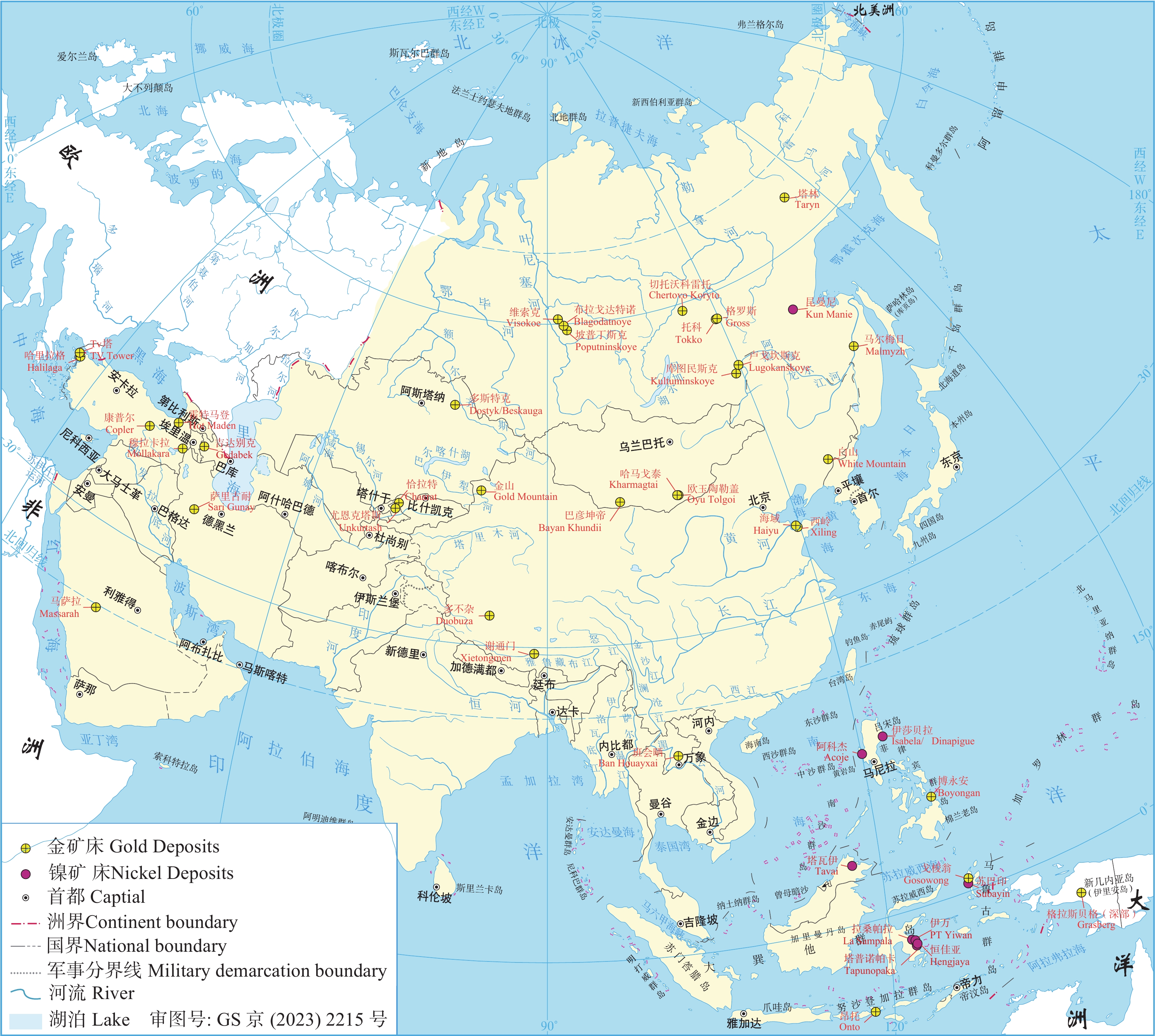
据不完全统计,21世纪以来,全球勘查新发现了161个大型金矿床(S&P Global Market Intelligence,2024),其中,有35个分布在亚洲大陆(包括俄罗斯位于亚洲大陆的区域内新发现的金矿床,下同)(图1),约占全球勘查新发现大型金矿床总数量的21.74%,是全球勘查新发现大型金矿床数量第二多的大洲。
|
图 1 21世纪以来亚洲大陆勘查新发现44个金、镍(钴)矿床分布简图 |
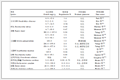
从国家分布看,21世纪以来,亚洲勘查新发现的35个大型金矿床主要分布在阿塞拜疆、俄罗斯、菲律宾、哈萨克斯坦、吉尔吉斯斯坦、老挝、蒙古、沙特、土耳其、伊朗、印度尼西亚和中国等12个国家;其中,俄罗斯是新发现大型金矿床数量最多的国家,有10个,其次为中国和土耳其,其余9个国家新发现的大型金矿床数量均不足5个(表1)。
|
表 1 21世纪以来亚洲大陆勘查新发现35个金矿床地质特征一览 |
从新发现金矿床规模看,21世纪以来,全球勘查新发现金总量(储量+资源量(不含储量)+发现以来产量,下同)大于500 t的金矿床有13个,其中,有5个分布在亚洲,印度尼西亚2013年发现的昂托金铜矿床,金总量约1019 t,居近10年以来全球勘查新发现金矿床规模的第4位、亚洲第1位(表1)。
从矿床类型看,勘查新发现金矿床类型有浅成低温热液型、斑岩型、黑色岩系型、石英脉型、矽卡岩型、卡林型、VMS型、破碎带蚀变岩型等,从上述各类型新发现的金矿床数量看,以浅成低温热液型为主,其次是斑岩型,其他类型相对较少(表1)。
从成矿时代看,勘查新发现金矿成矿时代有元古宙、古生代、中生代和新生代,以中生代、新生代为主,其次为古生代,元古宙相对较少;其中,中生代和新生代新发现金矿床主要分布在阿塞拜疆、俄罗斯、菲律宾、土耳其、伊朗、印度尼西亚和中国,古生代新发现金矿床主要分布在哈萨克斯坦、吉尔吉斯斯坦、老挝、蒙古和中国,元古宙新发现金矿床主要分布在俄罗斯及沙特(表1)。
从成矿(区)带看,新发现金矿床主要分布在特提斯成矿域、环太平洋成矿域、古亚洲成矿域及西伯利亚克拉通成矿域、阿拉伯克拉通成矿域、中朝克拉通成矿域的次级成矿带内,以古亚洲成矿域的乌拉尔—蒙古成矿带和特提斯成矿域的西亚成矿带为主(表1)
2 勘查新发现镍(钴)矿床特征21世纪以来,全球勘查新发现大型镍矿床约19个,其中,有9个分布在亚洲,主要分布在印度尼西亚、菲律宾、俄罗斯及马来西亚4个国家(图1),其中,印度尼西亚是新发现大型镍矿床数量最多的国家,有5个,占亚洲新发现大型镍矿床总数的55.56%;其次为菲律宾,新发现大型镍矿床2个(表2)。
|
|
表 2 21世纪以来亚洲大陆勘查新发现9个镍(钴)矿床地质特征一览 |
从新增镍金属总量(储量+资源量(不含储量)+发现以来产量,下同)看,21世纪以来,全球新发现大型镍矿床的镍金属总量约3616.48万t,其中,亚洲新发现大型镍矿床的镍金属总量为1937.07万t,占全球的53.56%;印度尼西亚新发现大型镍矿床的镍金属总量为1438.89万t,占亚洲的74.28%,占全球的39.79%,是21世纪以来全球新发现大型镍矿床新增镍金属总量最多的国家。
从矿床类型看,勘查新发现镍矿床以红土型为主,其次为岩浆型,其中,红土型镍矿的矿体主要赋存在红土风化壳中,岩浆型镍矿的成矿作用主要与基性—超基性岩有关(表2)。
从成矿时代看,勘查新发现镍矿床成矿时代为中生代至新生代,以新生代为主。同时,成矿时代与矿床类型存在一定的联系,新发现红土型镍矿床主要形成于新生代,新发现岩浆型镍矿床主要形成于中—新生代(表2)。
从成矿(区)带看,新发现镍矿床主要分布在特提斯成矿域和环太平洋成矿域及古亚洲成矿域的次级成矿带内,以前两者为主(表2)。
Akimov G Y, Kryuchkov A V, Krylova T L, Sviridov A A. 2004. TheTaryn vein–disseminated ore deposit: A new type of gold mineralizationin the Verkhnyaya Indigirka region, Yakutia[J]. Doklady Earth Sciences, 397A(6): 363-368. |
Braxton D P, Cooke D R, Ignacio A M, Waters P J. 2018. Geology of the Boyongan and Bayugo porphyry Cu−Au deposits: An emerging porphyry district in northeast Mindanao, Philippines[J]. Economic Geology, 113(1): 83-131. DOI:10.5382/econgeo.2018.4545 |
Carlile J C, Davey G R, Kadir I, Langmead R P, Rafferty W J. 1998. Discovery and exploration of the Gosowong epithermal gold deposit, Halmahera, Indonesia[J]. Journal of Geochemical Exploration, 60: 207-227. DOI:10.1016/S0375-6742(97)00048-4 |
Chen Xifeng, Chen Xiufa, Ye Jinhua, Lin Fangcheng, Shi Meifeng, Yu Rui. 2020. The Mineral Resources of Southeast Asia[M]. Beijing: Geological Publishing House(in Chinese).
|
Çolakoğlu A R, Oruç M, Arehart G B, Poulson S. 2011. Geology and isotope geochemistry (C–O–S) of the Diyadin gold deposit, Eastern Turkey: A newly–discovered Carlin–like deposit[J]. Ore Geology Reviews, 40: 27-40. DOI:10.1016/j.oregeorev.2011.04.002 |
Davaasuren O E, Koh S M, Kim N, Lee B H. 2021. Late Paleozoic adakitic magmatism in the Zogdor Cu occurrences, southern Mongolia, and their tectonic implications: New SHRIMP zircon age dating, Lu–Hf isotope systematics and geochemical constraints[J]. Ore Geology Reviews, 138: 104356. DOI:10.1016/j.oregeorev.2021.104356 |
Gibsher N A, Ryabukha M A, TomilenkoA A, SazonovA M, Khomenko M O, Bul’bakT A, Nekrasova N A. 2017. Metal–bearing fluids and the age of the Panimba gold deposit (Yenisei Ridge, Russia)[J]. Russian Geology and Geophysics, 58: 1366-1383. DOI:10.1016/j.rgg.2017.11.004 |
Hosseini S T, Asghari O, Haroni H A. 2020. Multivariate anomaly modeling of primary geochemical halos by U–spatial statistic algorithm development: A case study from the Sari Gunayepithermal gold deposit, Iran[J]. Ore Geology Reviews, 127: 10384. |
Hutchison C S. 2005. Geology of North–West Borneo[M]. Elsevier Science, 373–375.
|
İsmayıl C, Özen Y, Arık F, Veliyev A. 2020. Genesis of the Gedabek Au–Ag–Cu deposit (Azerbaijan) in the Lesser Caucasus: Insights from geochemistry, fluid inclusion and sulfur isotope[J]. Journal of Asian Earth Sciences, 206: 104627. |
Kolmakov Y V. 2014. The Blagodatnoe gold–sulfide deposit (Yenisei Ridge, Russia): The nature of geophysical anomalies and the succession and causes of formation of petrophysical zoning[J]. Russian Geology and Geophysics, 55(11): 1321-1332. DOI:10.1016/j.rgg.2014.10.007 |
Petrov O V, Khanchuk A I, Ivanov V V, Shatov V V, Seltmann R, Dolgopolova A V, Alenicheva A A, Molchanov A V, Terekhov A V, Leontev V I, Belyatsky B V. 2021. Porphyry indicator zircons(PIZ)and geochronology of magmatic rocks from the Malmyzh and Pony Cu–Au porphyry ore fields (Russian Far East)[J]. Ore Geology Reviews, 139(A): 1-22. |
Shao Xingkun, Li Qingquan, YanYan, Chen Yu, Song Linxu, Mao Yongxin. 2015. Stable isotopes geochemical characteristics of gold deposit in Baishan(Hunjiang), Jilin Province J]. Jilin Geology, 34(4): 31–35 (in Chinese with English abstract).
|
S&P Global Market Intelligence. 2024. Commodities [EB/OL]. (2024–03–26). https://www.capitaliq.spglobal.com/web/client?auth=inherit&OktaLogin=true#dashboard/metalsAndMining.
|
The Writing Group of world mineral fact, Asia . 2023. World Mineral Fact, Asia(second edition)[M]. Beijing: Geological Publishing House(in Chinese).
|
Wang Jian, Zhu Lixin, Ma Shengming, Tang Shixin, Zhang Liangliang, Zhou Weiwei. 2019. Application of the multi–attribute anomaly model for prospecting potentialat depth: A case study of the Haiyu Au deposit in the Jiaodong Gold Province, China[J]. Journal of Geochemical Exploration, 207. https://doi.org/10.1016/j.gexplo.2019.106359.
|
Wang Rui, Tafti R, HouZengqian, Shen Zhichao, Guo Na, Evans N J, Jeon H, Li Qiuyun, Li Weikai. 2017. Across–arc geochemical variation in the Jurassic magmatic zone, Southern Tibet: Implication for continental arc–related porphyry Cu–Au mineralization[J]. Chemical Geology, 451: 116-134. DOI:10.1016/j.chemgeo.2017.01.010 |
Yigit O. 2006. Gold in Turkey: A missing link in Tethyan Metallogeny[J]. Ore Geology Reviews, 28: 147-179. DOI:10.1016/j.oregeorev.2005.04.003 |
Yigit O. 2012. A prospective sector in the Tethyan Metallogenic Belt: Geology and geochronology of mineral deposits in the Biga Peninsula, NW Turkey[J]. Ore Geology Reviews, 46: 118-148. DOI:10.1016/j.oregeorev.2011.09.015 |
Yu Bing, Zeng Qingdong, Frimmel H E, Fan Hongrui, Xue Jianling, Yang Jinhu, Wu Jinjiang, Bao Zhian. 2024. Spatio–temporal fluid evolution of gold deposit in the Jiaodong Peninsula, China: A case study of the giant Xiling deposit[J]. Journal of Geochemical Exploration, https://doi.org/10.1016/j.gexplo.2024.107455.
|
Yudovskaya M A, Distler V V, Prokofiev V Y, Akinfiev N N. 2016. Gold mineralisation and orogenic etamorphism in the Lena province of Siberia as assessed from Chertovo Koryto and Sukhoi Log deposits[J]. Geoscience Frontiers, 7: 453-481. DOI:10.1016/j.gsf.2015.07.010 |
Zhu Yiguang, Liu Jiajun, Zhu Bingyu, Yang Longbo. 2011. Sulfur, lead and carbon isotope composition and tracing for the ore–forming materials in the Jinshan gold deposit, Xinjiang[J]. Gold, 32(11): 10-15 (in Chinese with English abstract). |
Zhu Xiangping, Li Guangming, Chen Huaan, Ma Dongfang, Zhang Hai, Zhang Hong, Liu Chaoqiang, We Lujie. 2017. Petrogenesis and metallogenic setting of porphyries of the Duobuza porphyry Cu–Au deposit, central Tibet, China[J]. Ore Geology Reviews, 89: 858-875. DOI:10.1016/j.oregeorev.2017.07.013 |
Zu Bo, Xue Chunji, Chi Guoxiang, Pak Nikolay, Zhao Xiaobo, Wang Xinli. 2018. Age and petrogenesis of the Andagul granodiorite and its implications on gold mineralization of the Kassan region, western Kyrgyzstan Tian Shan[J]. Ore Geology Reviews, 101: 54-73. DOI:10.1016/j.oregeorev.2018.07.007 |
Zorin Y A, Zorina L D, Spiridonov A M, Rutshtein I G. 2001. Geodynamic setting of gold deposits in Eastern and CentralTrans–Baikal (Chita Region, Russia)[J]. Ore Geology Reviews, 17: 215-232. DOI:10.1016/S0169-1368(00)00015-9 |
陈喜峰, 陈秀法, 叶锦华, 林方成, 施美凤, 于瑞. 2020. 东南亚矿产资源概论[M]. 北京: 地质出版社.
|
《世界矿情·亚洲卷》编写组. 2023. 世界矿情·亚洲卷(第二版)[M]. 北京: 地质出版社, 3–171.
|
邵兴坤, 李清泉, 闫岩, 陈宇, 宋林旭, 毛永新. 2015. 吉林白山金矿床稳定同位素地球化学特征[J]. 吉林地质, 34(4): 31-35. |
朱亿广, 刘家军, 朱炳玉, 杨隆勃. 2011. 新疆金山金矿床硫铅碳同位素组成及对成矿物质的示踪[J]. 黄金, 32(11): 10-15. |