
 PDF
PDF


2. 自然资源部中国地质调查局海岸带地质环境重点实验室, 天津 300170;
3. 天津市地质过程与环境安全重点实验室, 天津 300170;
4. 天津师范大学, 天津 300387
2. Key Laboratory of Coast Geo−environment, China Geological Survey, Ministry of Natural Resources, Tianjin 300170, China;
3. Tianjin Key Laboratory of Coast Geological Processes and Environmental Safety, Tianjin 300170, China;
4. Tianjin Normal University, Tianjin 300387, China
[Objective] More and more high resolution paleoclimatic records confirm that a number of subcentennial climate abrupt change events were exit in the Holocene. Such abrupt climate change events had a very close relationship with the social and economic development of human. 4.2 ka BP event are recorded in Asia, North America, the Mediterranean, Southern Europe and other places which indicated that this event were global in extent. However, the record of this evnent has not been adequently substantiated in the coastal zone, especially in northern China muddy coastal zones. [Methods] This paper focuses on three buried oyster reefs and their overlying mud layers located 1−6 km apart on the northwest coast of Bohai Bay, namely Lingtou, Zengkouhe and the sourthern part of Biaokou. Through diatom analysis (83 samples), AMS 14C dating (32 data) and sedimentological research, the environmental information recorded by the reefs and overlying mud layers was reconstructed, and the possible imprints of the ‘4.2 ka BP event’ in the coastal zone were discussed. [Results] The study area experienced a transgression−regression environment evolution from upper tidal salt marsh to intertidal zone in the Early Holocene→subtidal zone to lower and middle part of intertidal zone to middle and upper part of intertidal zone in the Mid−Holocene→salt marsh lowlands in the Late Holocene. At about 7 ka cal BP ago, three reefs appeared one after another, and as the reefs build up, the influence of the seawater become weakened. At about 5−4.3 ka cal BP, the three reefs entered the lower and middle part of the intertidal zone, the climate became colder and lead the three reefs be buried at the same time of 4.2−4 ka cal BP and covered by the overlying mud immediately. [Conclusions] A climate fluctuation process occurred during 5−4 ka cal BP in the study area. The climate became colder during 5−4.3 ka cal BP, and gradually warmed after 4.3 ka cal BP. The turning point of the climate change occurred at about 4.3 ka cal BP. We speculate that this climate fluctuation was probably a response to the ‘4.2 ka BP event’ in the north muddy coast of China.
渤海湾西北部沿海平原(“牡蛎礁平原”)和毗邻浅海区的一个典型而独特的地质现象,是存在众多的全新世埋藏牡蛎礁体,目前在约3500 km2的范围内已发现了50余处,按它们的时空分布,可大致划分为10个礁群(王宏等, 2006;王海峰等, 2011;商志文等, 2013
硅藻是海洋中重要的微体植物之一,因水体物理、化学及水动力条件的差异,其种类、数量及组合特征存在明显的多样性。因此,可以通过沉积物中化石硅藻的特征推断古海洋环境和古气候条件(王开发等, 1995, 2002a, b, 2003;Sato et al., 2001, 2003;支崇远等, 2003;李超等, 2004;Freund et al., 2004;黄玥等, 2006;冉莉华等, 2008;李冬玲等, 2009;商志文等, 2010a, b; Fukumoto, 2011;Saegusa et al., 2011; Hofmann et al., 2020; Cho et al., 2022; Shang et al., 2023, 2024)。
地质历史时期的极端气候事件研究是近三十年来地球科学领域的热点问题(钟焱等, 2020;姜兴钰等, 2022)。4.2 ka BP气候异常事件被认为是一次全球或至少是北半球气候异常事件。亚洲、非洲、欧洲和北美洲的记录表明,该事件的开始时间、历时和强弱程度均相似,多发生于4.3~4.1 ka BP,主要表现为气候干旱(刘浴辉等, 2013)。同时,大量证据显示“4.2 ka BP事件”是造成这一时期世界范围的史前文明衰落和民族迁徙的重要原因(Wess et al., 1993;许靖华, 1998;Cullen et al., 2000;Perry and Hus, 2000;连鹏灵和方修琦, 2001)。目前,中国大部分区域均发现了4.2 ka BP气候突变事件的记录。An et al. (2005)对中国西部黄土高原的研究结果显示,在4.0 ka BP左右气候由湿润转入干旱。Xu et al. (2002)、Hong et al. (2003)和Wang et al. (2010)对青藏高原东部红原泥炭δ18O和δ13C等指标的分析数据显示,4.2 ka BP左右气候干冷。张美良等(2006)通过对云南宁蒗县永宁区仙人洞石笋α−U系定年和δ18O和δ13C分析,指出4.0~3.4 ka BP气候寒冷干旱。重庆新崖洞XY6石笋在4.1~3.2 ka BP期间相对偏正的δ18O和δ13C值指示气候相对干冷(李延勇等, 2006)。申洪源等(2006)对内蒙古黄旗海湖泊沉积物不同粒级中Rb和Sr分布规律研究发现,在4.3 ka BP左右出现降温事件。长江三角洲孢粉数据显示,4.8~3.8 ka BP间气候干冷(Yi et al., 2003)。中国东海福建海岸泥地沉积物研究发现,3.8 ka BP左右东亚冬季风变弱且不稳定(Liu et al., 2010)。这些记录的载体有黄土、泥炭、湖泊、洞穴碳酸盐(石笋)和三角洲等,其中湖泊和石笋的分辨率最高,可达到数十年级别。但是,在海陆交互的海岸带,特别是中国北方泥质海岸带地区,该事件的记录迄今未得到充分证实。
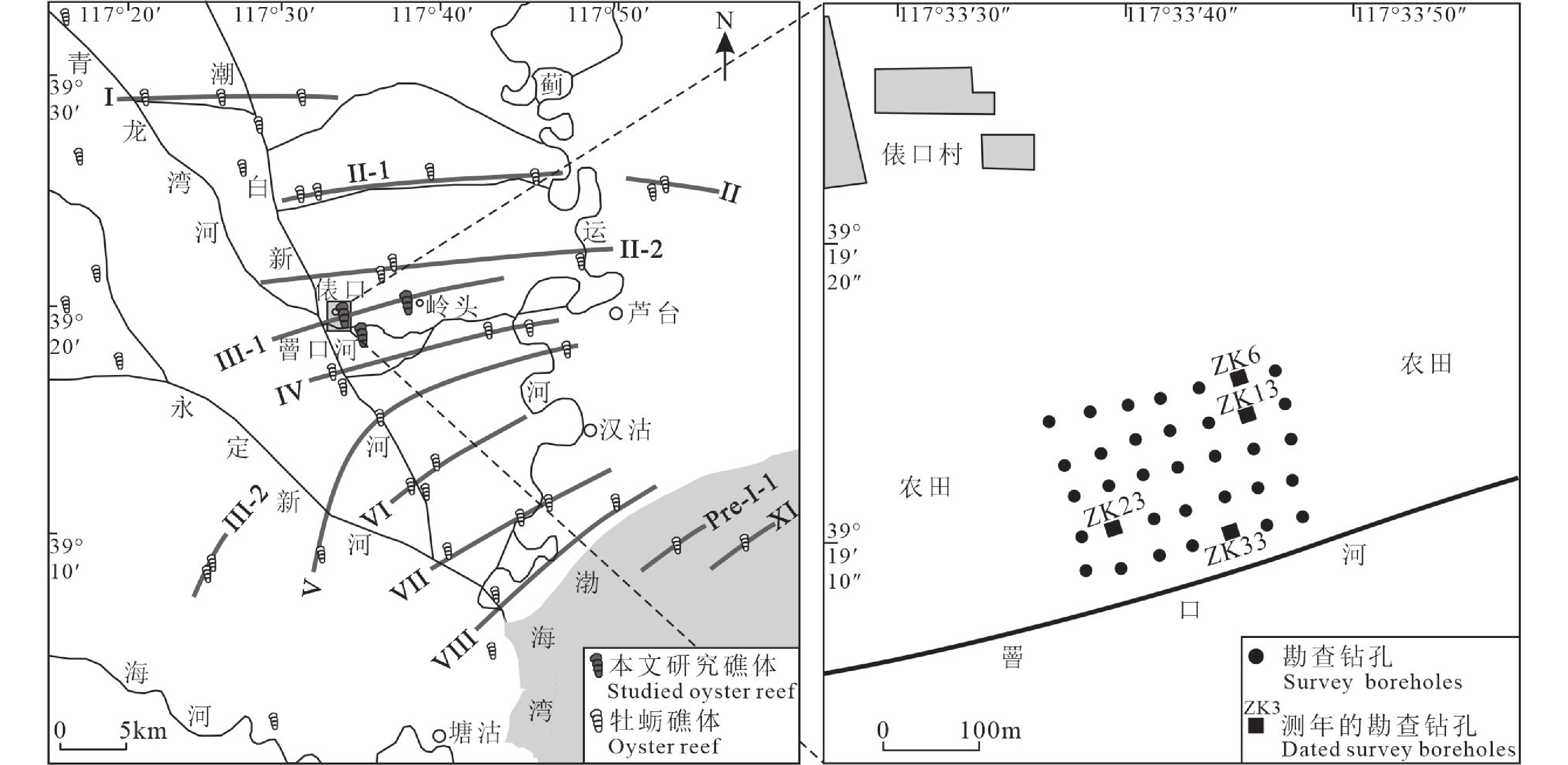
本文以在礁体灭亡时间上与“4.2 ka BP事件”吻合的渤海湾西北岸礁群III-1中俵口南部、罾口河以及岭头礁体及其上覆泥层为研究对象(图1),通过沉积学、年代学和古生物学手段,重建该时段礁体及上覆泥层所记录的古环境信息,同时探索可能存在的“4.2 ka BP事件”在海岸带的印记。
|
图 1 俵口南部、岭头和罾口河礁体位置图 I~XI—按时空分布位置所做的礁群编号 Fig. 1 Location map of south Biaokou, Lingtou and Zengkouhe oyster reefs I−XI–Oyster reef group numbering based on spatiotemporal distribution |
俵口南部礁体位于天津市宁河区俵口村南部、罾口河北侧,在该礁体实施了35个孔深为12 m机械钻孔,孔间距40 m,各钻孔均钻遇并穿透牡蛎礁体,礁体厚3.0~6.0 m(平均5.0 m),上覆泥层厚2.7~3.7 m(平均3.1 m)(秦磊等, 2017)。岭头礁体位于河北省唐山市丰南区岭头村,剖面揭露礁体厚度2.2 m,上覆泥层厚3.1 m。罾口河礁体位于天津市宁河区俵口村罾口河南侧,剖面揭露礁体厚度2.4 m,上覆泥层厚2.7 m(图1)。
分别从俵口村南部礁体ZK6、ZK23、ZK13和ZK33钻孔上覆和下伏泥层采取8个贝壳样品用于AMS 14C年龄测定。从ZK23孔礁体上覆和下伏泥层中采集54个样品,取样间距10 cm,用于硅藻分析。
结合在岭头和罾口河2处礁体已发表的年代学(商志文等, 2016)和硅藻数据(商志文, 2010b, 2013
|
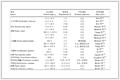
表 1 俵口南部、岭头与罾口河牡蛎礁剖面AMS 14C测年结果 Table 1 AMS 14C dating results of south Biaokou, Lingtou and Zengkouhe oyster reefs |
俵口南部礁体8个14C测年样品均采自岩心中相对完整的单瓣贝壳,在Beta实验室以AMS(加速器质谱)方法进行14C测年。测定值以5568半衰期计年,所有样品的测试结果均据其δ13C值进行分馏效应校正成为惯用年龄。在惯用年龄的基础上依Marine13海洋曲线进行了包括海洋贮存库效应在内的系统校正。海洋贮存库校正值是(−178±50)a(CALIB, Connected to marine database)(Southon et al., 2002)(表1)。
俵口南部礁体ZK23孔硅藻分析样品在自然资源部中国地质调查局海岸带地质环境重点实验室按照常规方法处理(Richard and Battarbee, 1986),过程依次为:30%双氧水去除有机质、10%盐酸去除钙质、比重为2.38的ZnBr2重液浮选两次、加拿大树胶封片,制成玻片后,在400倍显微镜下鉴定属种。
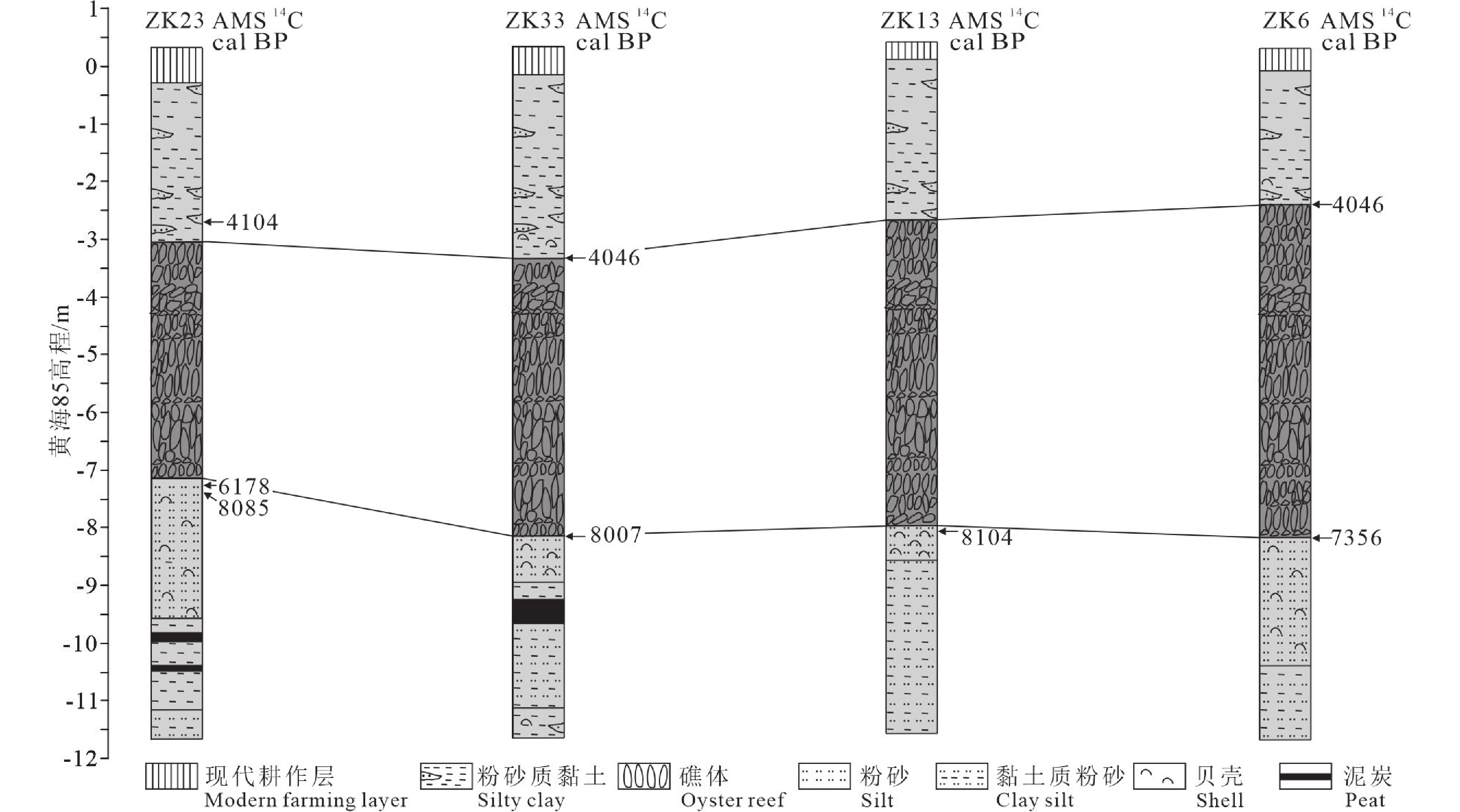
3 结 果 3.1 年代学俵口村南部礁体8个AMS 14C年龄由下向上表现出依次年轻的自恰性,且4个钻孔礁体顶部、底部年龄基本一致(表1,图2),显示该礁体发育年代为6178~4046 cal BP(表1,图2)。表1显示剖面揭露的岭头和罾口河礁体起讫年代分别是4378~4234 cal BP和7123~4212 cal BP(商志文等, 2016)。虽然这3处礁体开始发育的时间不同,历时也不同,但是几乎同时在4.2~4 ka cal BP结束建礁(表1,图2),而这一时间段与“4.2 ka BP事件”吻合。
|
图 2 俵口村南部礁体年龄分布图 Fig. 2 Distribution diagram of the age in the south Biaokou oyster reef |
对俵口南部礁体ZK23孔、岭头(商志文等, 2010b)和罾口河礁体剖面(商志文等, 2013
Cyclotella striata和Cyclotella stylorum为潮间带—沿岸种,潮间带地区含量高达30%以上,最多达80%,自岸向海数量减少,水深大于30 m海区,数量一般小于15%。这两个种在中国北黄海沿岸、黄海、东海、南海北部湾等地均有记录(蒋辉, 1987),为渤海湾海岸带第一优势硅藻种(商志文等, 2012)。
Actinoptychus undulatus为广布性的沿岸底栖种,该种的最高含量出现在南黄海和东海水深40 m左右的浅海区,含量大于30%,大于或小于这个水深,数量明显减少(蒋辉, 1987)。在渤海湾潮间带—浅海区表层沉积物中,潮间带地区含量低于浅海区(商志文等, 2012)。
Coscinodiscus argus, Coscinodiscus radiatus 为广布性浮游种,在渤海湾潮间带—浅海区表层沉积物中,含量随水深的变化不明显(商志文等, 2012)。
Coscinodiscus perforatus, Surirella armoricana均为沿岸底栖种。在渤海湾潮间带—浅海区表层沉积物中,Coscinodiscus perforatus 在海河北部潮间带至2 m水深的浅海区含量最高。Surirella armoricana主要分布在浅海区,且随着水深加大,含量逐渐增多(商志文等, 2012)。
Paralia sulcata为典型的浅海种,是中国表层沉积物中分布最广泛的种类之一,从岸线到浅海,数量逐渐增加,而从浅海到深海区或海槽,含量则逐渐减少,水深50~100 m最适合其生长(蒋辉, 1987)。在渤海湾潮间带—浅海区表层沉积物中,该种主要分布在浅海区,且随着水深的增加,数量逐渐增多(商志文等, 2012)。
Deploneis bombus为沿岸底栖种(金德祥等, 1982;郭玉洁和钱树本, 2003),Grammatophora oceanica为潮间带种(王开发和蒋辉, 1987),Tryblioptychus cocconeiformis为近岸浅海种(蒋辉, 1987), Auliscus caelatus为砂质潮间带指示种(Kosugi, 1988)。
Thalassionema nitzschioides为亚热带浮游种,在世界各大洋均有分布,在近岸浅海区也有相当数量。该种在中国四大海域均有分布,主要分布在南海及东海陆坡和海槽,海水温度、盐度均较高,是渤海湾10~20 m水深表层沉积硅藻优势种之一(蒋辉, 1987;商志文等, 2012)。
3.3 古环境重建利用Tilia软件对俵口南部礁体ZK23孔、岭头和罾口河礁体剖面硅藻种进行聚类分析,划分了硅藻组合带,各礁体硅藻组合特征及古环境如下:
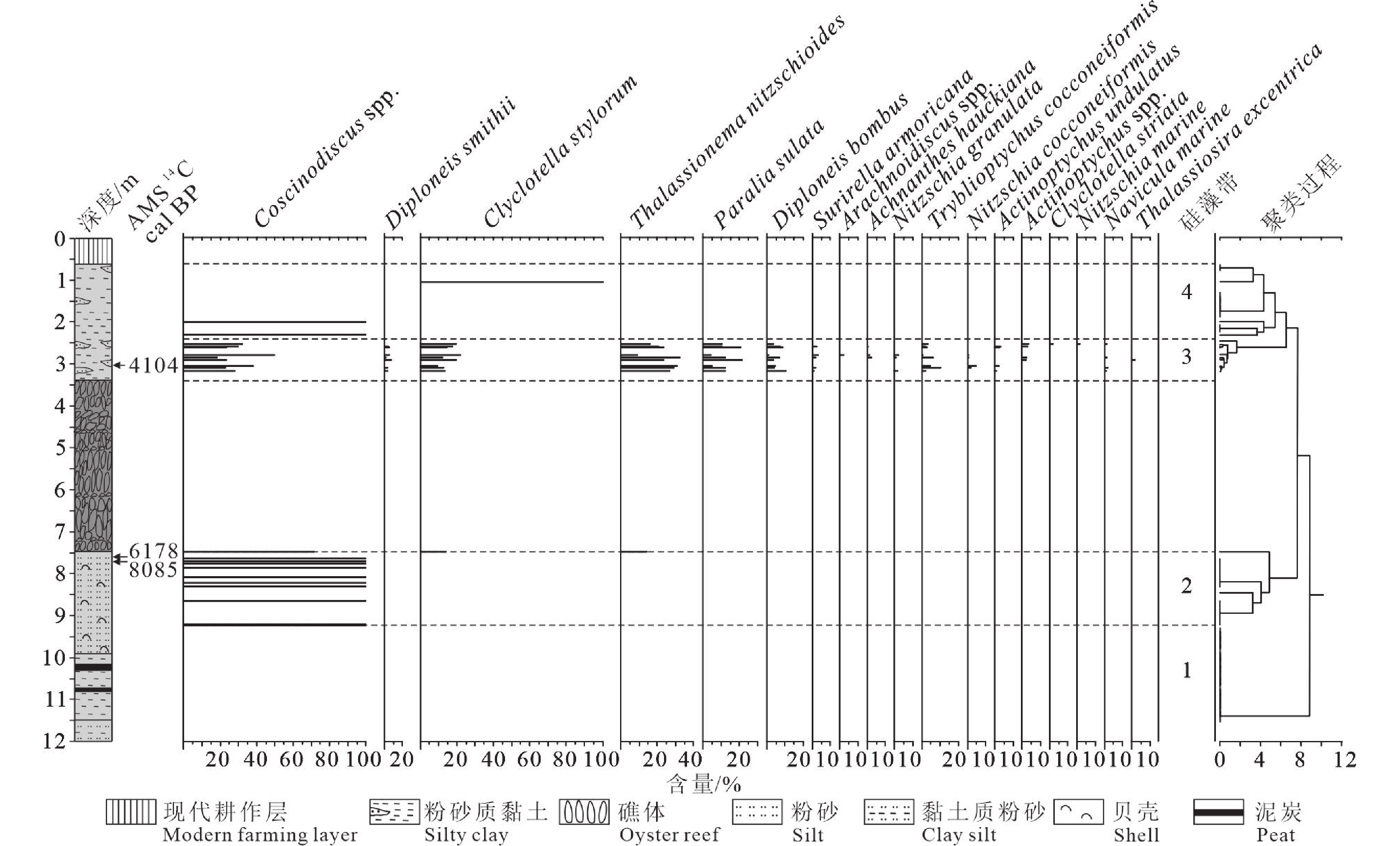
俵口南部礁体由于机械钻探过程中礁体部分受到扰动未采集样品,礁体上覆和下伏泥层样品的硅藻分析结果显示该孔共划分4个硅藻组合带(图3):组合1带,埋深9.2~12 m,其中11.5~12 m为粉砂与黏土的互层;11.5~9.9 m为粉砂质黏土,层内发育泥炭层(10.15~10.3 m)和碳质条带(10.7~10.8 m),泥炭层以泥为主,色调极黑、细腻,可见未分解的植物;9.2~9.9 m为砂泥质沉积,棕灰色(10YR 4/1),以粉砂为主,含少量泥,块状层理,含大量海相贝壳碎屑。该段未检测出硅藻,根据沉积特征推测该段为潮上带盐沼至潮间带沉积环境。组合2带,埋深7.5~9.2 m,为砂泥质沉积,棕灰色(10YR 4/1),以粉砂为主,含少量泥,块状层理,含大量海相贝壳碎屑。埋深7.70 m和7.58 m的AMS 14C年龄分别是8085 cal BP和6178 cal BP。该带仅检测出零星海相Coscinodiscus spp.硅藻碎片,推测为潮下带沉积环境。组合3带,埋深2.4~3.4 m,粉砂质黏土,棕灰色(10YR 4/1),含粉砂团,该带硅藻丰富,以Cyclotella stylorum−Coscinodiscus spp.−Thalassionema nitzschioides−Paralia sulcata为组合特征,4个优势种的含量>75%,另见沿岸种Deploneis bombus、Deploneis smithii和Surirella armoricana及近岸浅海种Tryblioptychus cocconeiformis等,该带以潮间带—近岸浅海种组合为特征,推测为潮间带沉积环境。组合4带,埋深0.7~2.4 m,粉砂质黏土,浊黄棕色(10YR 5/3),无层理,发育铁锰核和铁质浸染,可见不规则分布的粉砂团,该带仅检测出零星海相Coscinodiscus spp.硅藻碎片和Cyclotella stylorum,推测为河流泛滥形成的沼泽−盐沼环境。
|
图 3 ZK23孔岩心柱状图与硅藻组合特征 Fig. 3 Histogram and diatom assemblages of borehole ZK23 |
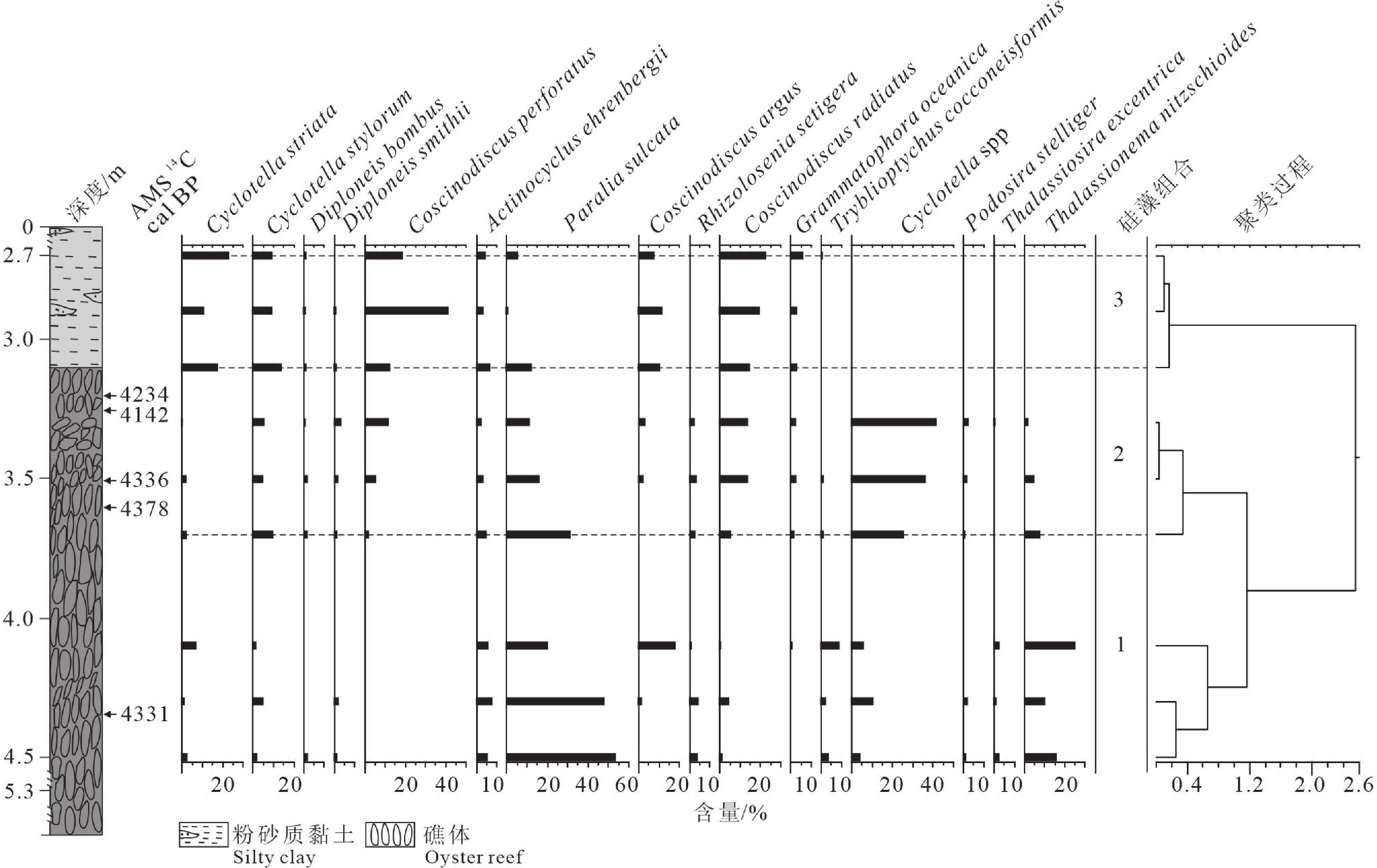
岭头礁体剖面上覆泥层和礁体内泥质样品的硅藻分析显示该剖面共划分3个硅藻组合带(图4)(商志文等, 2010b),其中组合1带埋深3.7~4.5 m(礁体下部),以近岸浅海种与海洋浮游种为主,含少量的沿岸种与非浮游种,以Paralia sulcata−Thalassionema nitzschioides−Cyclotella. spp.组合为特征,推测为潮下带至潮间带下部沉积环境。组合2带埋深3.1~3.7 m(礁体上部),以潮间带沿岸种与非浮游种为主,近岸浅海种与海洋浮游种为辅,以Cyclotella spp.−Paralia sulcata−Coscinodiscus radiatus 组合为特征,推测为潮间带中下部沉积环境。组合3带,埋深2.7~3.1 m(礁体上覆泥层),以潮间带沿岸种与非浮游种为主,含少量浅海种和浮游种,以Cyclotella striata/stylorum−Coscinodiscus perforatus−Coscinodiscus radiatus组合为特征,推测为潮间带中上部环境。
|
图 4 岭头礁体剖面图与硅藻组合特征(据商志文等, 2010b修改) Fig. 4 Histogram and diatom assemblages of Lingtou oyster reef (modified from Shang Zhiwen et al., 2010b) |
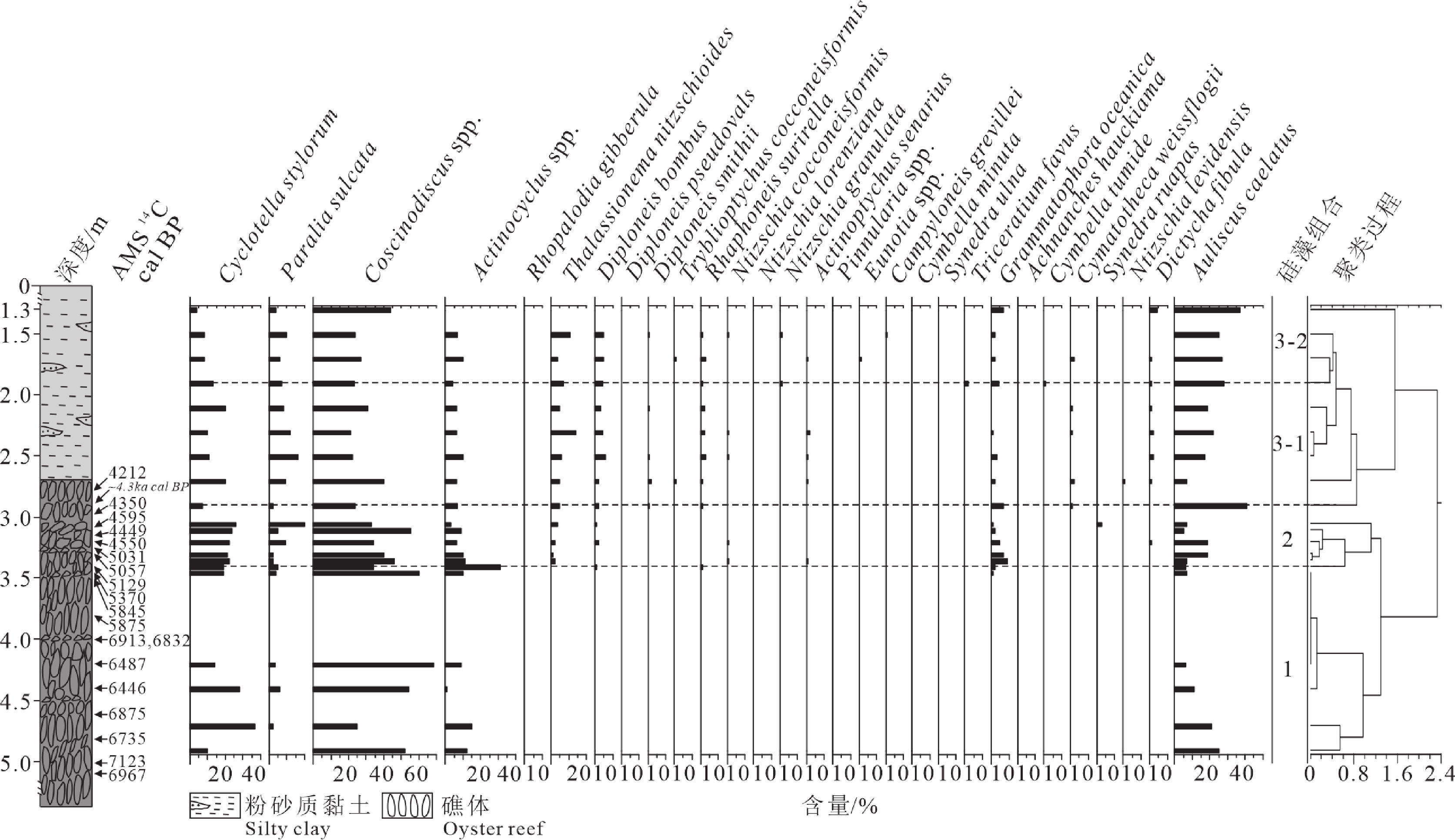
罾口河礁体剖面上覆泥层和礁体内样品的硅藻分析显示该剖面共划分3个硅藻组合带和2个组合亚带(图5)。其中,组合1带埋深3.4~4.9 m,硅藻组合以Coscinodiscus spp.−Cyclotella stylorum−Auliscus caelatus−Paralia sulcata为特征,推测为潮下带环境。组合2带埋深2.9~3.4 m,硅藻组合以Coscinodiscus spp.− Cyclotella stylorum−Auliscus caelatus−Actinocyclus spp.为特征,与组合1带相比,潮间带沿岸种的种类和含量开始增多,推测为潮间带中下部环境。硅藻组合3带以Coscinodiscus spp.−Auliscus caelatus−Cyclotella stylorum−Paralia sulcata为特征,组合3-1亚带埋深1.9~2.9 m,半咸水和潮间带沿岸种从种类和数量上较2组合带均有增加,显示该段为潮间带中上部环境。组合3-2亚带埋深1.3~1.9 m,硅藻较为丰富,但顶部1.3 m处硅藻数量少,与组合3-1亚带相比见少量淡水种类,如Pinnalaria spp., Eunotia spp.和Cymbella tumide等,为潮间带顶部至受海水影响的潮上带环境。
|
图 5 罾口河礁体剖面图与硅藻组合特征(据商志文等, 2013
|
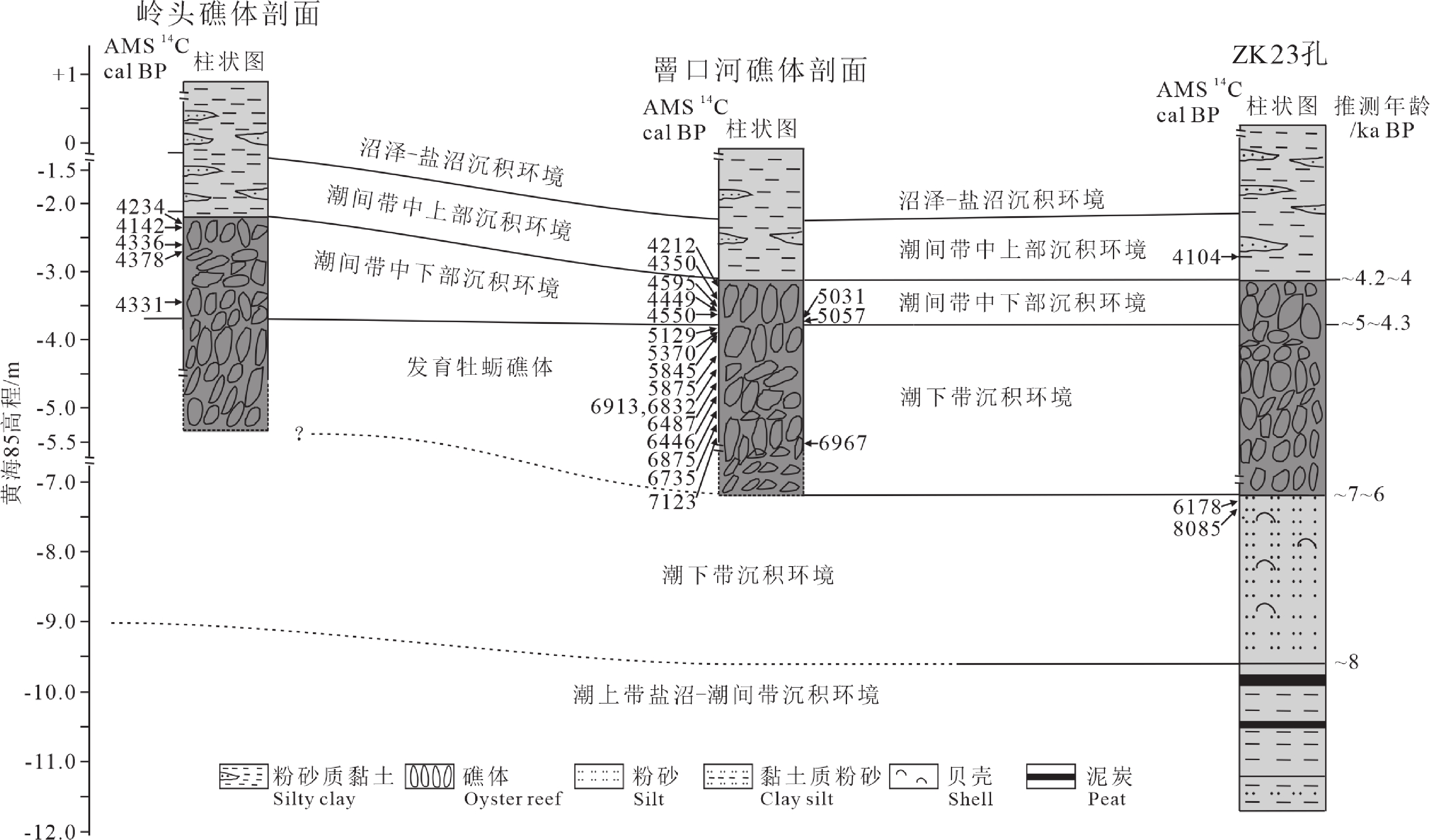
俵口南部、岭头和罾口河3处埋藏牡蛎礁体硅藻、加速器14C测年和沉积学古环境重建的联合剖面结果(图6)显示,研究区早全新世为潮上带盐沼至潮间带沉积环境,发育泥炭层。约8 ka cal BP以后,随着海面快速上升,全新世海侵逐渐达到向陆进侵的最大边界,研究区进入潮下带沉积环境,在约7 ka cal BP以来,俵口南部、岭头和罾口河3处牡蛎礁体先后出现。礁体初期生长在低潮线以下的浅水环境,随着礁体的向上建造水深逐渐变浅,海水影响减弱,在5~4.3 ka cal BP时,礁体进入潮间带中下部,并在4.2~4 ka cal BP时被上覆泥层覆盖,停止发育。之后,研究区逐渐脱离海水影响,由潮间带中上部进入沼泽−盐沼相沿海低地沉积环境并相继成陆。
|
图 6 岭头、罾口河和俵口南部礁体联合剖面与古环境重建 Fig. 6 Joint profile and paleoenvironment reconstruction of Lingtou, Zengkouhe and south Biaokou oyster reefs |
作为全新世两次最为强烈的气候突然变化,“8.2 ka BP 事件”和“4.2 ka BP事件”已有深入研究(王绍武, 2011;Masson-Delmotte et al., 2013)。“4.2 ka BP 事件”在亚洲、非洲、欧洲和北美洲均有记录,表明了它的全球性特征。Bond et al.(1997)认为该事件发生在4.3~4.1 ka cal BP,中点时间在4.2 ka cal BP。Mayewski et al.(2004)指出该事件的历时为4.2~3.8 ka cal BP。中国东北柳河Hani曲线指示该事件起止时间是5~3.8 ka cal BP(Hong et al., 2009)。从时间上可以看出,俵口南部、岭头和罾口河礁体均在4.2~4 ka cal BP结束建礁(图2~5,表1)。这些礁体开始发育的时间不同,但几乎同时在4.2~4 ka cal BP结束建礁,并且无一例外地被厚泥层掩埋。这一时间段大致与“4.2 ka BP事件”吻合,现有年代学证据表明,这可能是渤海湾特殊地质体—牡蛎礁,对该事件的响应。
硅藻分析结果也初步显示了3处礁体对“4.2 ka BP事件”的响应。浮游生物指示种是推断海洋环境的有力工具。菱形海线藻(Thalassionema nitzschioides)在分类学上隶属于硅藻门(Bacillariophyta)、羽纹硅藻纲(Pennate)、无壳缝目(Araphidiales)、脆杆藻科(Fragulariacea)、海线藻属(Thalassionema)。该种为亚热带浮游种,在世界各大洋均有分布,在近岸浅海区也有相当数量,在中国四大海域中均有分布,主要分布在南海及东海陆坡和海槽,海水温度、盐度均较高(蒋辉, 1987)。已有研究发现南海沉积硅藻中Thalassionema nitzschioides的群落结构与原有的温度变化记录具有较好的一致性,是较好的古温度指示钟(刘腾飞, 2015)。刘腾飞(2015)进一步研究了环境中不同温度对Thalassionema nitzschioides种群增长与种间竞争的影响,结果显示:温度对Thalassionema nitzschioides种群增长影响显著,其环境负载能力随温度的降低而降低;相反温度升高对其种群增长有促进作用,延长了种群生长时间,从而使Thalassionema nitzschioides种群密度增大。因此,Thalassionema nitzschioides可以作为指示海域古温度冷暖变化的指标。
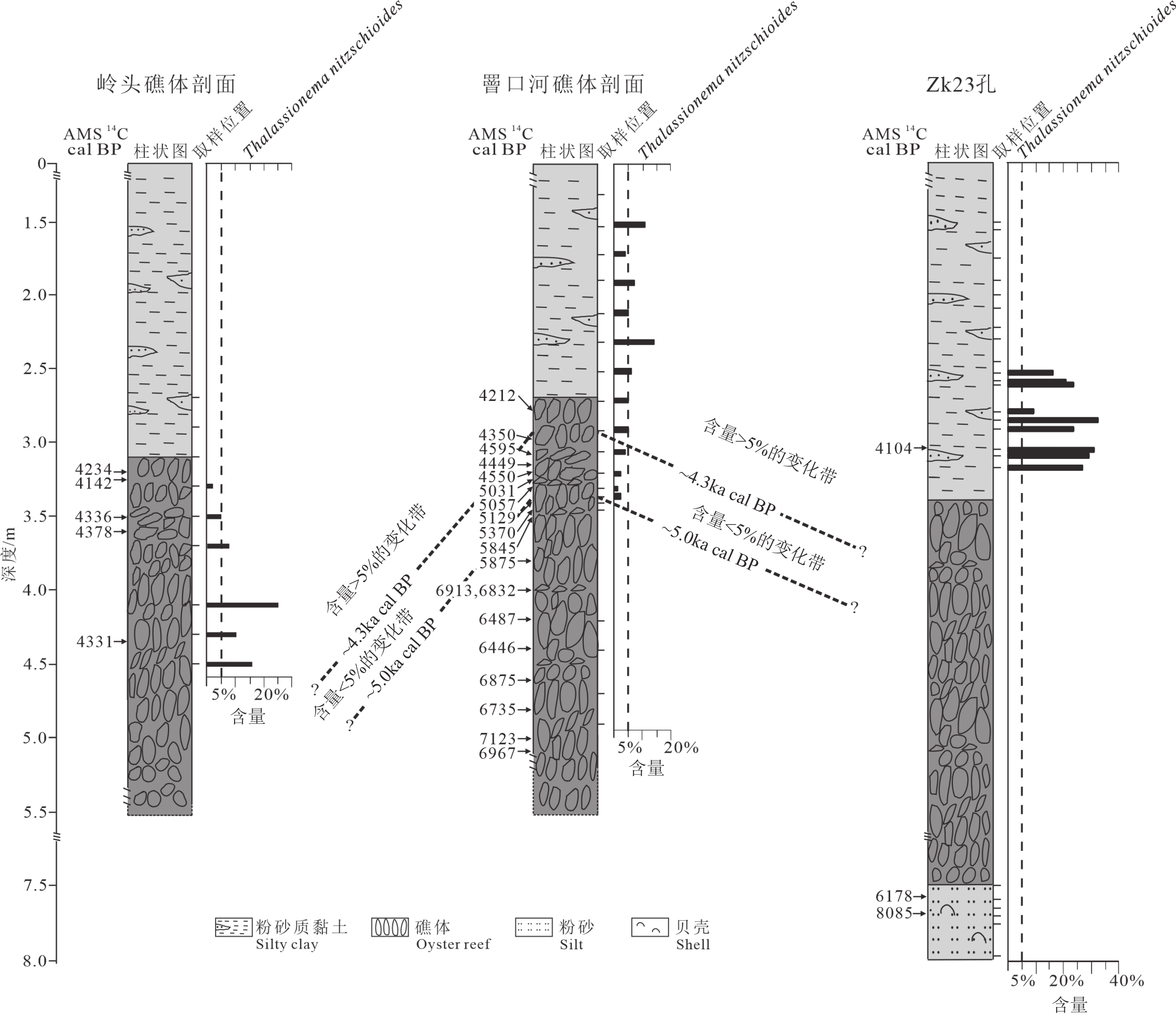
岭头、罾口河和俵口南部礁体年龄与Thalassionema nitzschioides含量分布图(图7)显示,在5~4.3 ka cal BP期间,Thalassionema nitzschioides含量<5%。4.3 ka cal BP后,该种的含量明显增加,为5%~30%。推测在5~4.3 ka cal BP时,研究区海水温度相对较低,抑制了Thalassionema nitzschioides种群增长,导致其在研究区硅藻群落中百分含量较低。4.3 ka cal BP后,海水温度相对升高,促进了Thalassionema nitzschioides种群增长,种群密度增大,进而增加了其在研究区硅藻群落中的百分含量。进一步推测研究区在5~4 ka cal BP发生了一次气候变化过程:在5~4.3 ka cal BP期间相对寒冷,4.3 ka cal BP后逐渐转暖,牡蛎礁及上覆泥层内硅藻记录的气候变化事件的转折点发生于约4.3 ka cal BP。
|
图 7 岭头、罾口河和俵口南部礁体年龄与Thalassionema nitzschioides含量分布图 Fig. 7 Ages and percentage distribution of Thalassionema nitzschioides in Lingtou, Zengkouhe and south Biaokou oyster reefs |
与区域及全球“4.2 ka BP事件”研究的对比分析显示,渤海湾记录的“4.2 ka BP事件”与亚洲、非洲和北美洲、甚至地中海国家和南欧等地区记录的“4.2 ka BP事件”相吻合,与全球的“4.2 ka BP事件”具有相关性。但是,亚洲、非洲、欧洲和北美洲的记录表明该事件多发生于4.3~4.1 ka BP,主要表现为气候干旱(刘浴辉等, 2013)。而本文的研究显示,此次气候的波动过程发生在5~4 ka cal BP期间,4.3 ka cal BP为气候变化的转折点。罾口河、岭头礁体剖面泥质沉积物氧稳定同位素和罾口河剖面孢粉分析结果也表明,4.5~4.3 ka cal BP时期研究区气候出现变冷变干的趋势,4.3~4.2 ka cal BP逐渐好转,气候变化的转折点发生在4.3 ka cal BP(商志文等, 2016),二者具有一致性。另外,与研究区较为接近的中国东北柳河Hani曲线记录的“4.2 ka BP事件”发生时间为5~3.8 ka cal BP(Hong et al., 2009),时间与本文的相当。4.3 ka cal BP之后,礁体仍向上继续建造了百余年;后期由于礁体生长至海面高度和泥砂沉积物的快速加积,停止发育。各处礁体被泥层覆盖,礁顶即便有侵蚀,也非常轻微,说明此次事件在渤海湾是一个相对和缓的渐变过程。这些均表明渤海湾记录的“4.2 ka BP事件”既有全球性又有区域特点。
5 结 论(1)俵口南部、岭头和罾口河3处埋藏牡蛎礁体的古环境重建结果显示,全新世以来,研究区依次经历了早全新世潮上带盐沼至潮间带→中全新世潮下带−潮间带中下部−潮间带中上部→晚全新世沼泽−盐沼低地沉积环境的海进−海退过程。在约7 ka cal BP以来,3处礁体先后出现在潮下带并开始向上建造;在5~4.3 ka cal BP时,礁体已生长至潮间带中下部,并在4.2~4 ka cal BP前后被上覆泥层覆盖,停止发育。
(2)礁体剖面泥质沉积物中硅藻分析结果进一步表明,研究区在5~4 ka cal BP发生了一次气候波动过程:5~4.3 ka cal BP期间相对寒冷,4.3 ka cal BP后逐渐转暖,气候变化事件的转折点发生于约4.3 ka cal BP。这一明显的环境变化是中国北方泥质海岸带地区对“4.2 ka BP事件”的响应。
致谢:Beta实验室提供AMS 14C测年数据,野外钻探由天津华北地质勘查局地质研究所完成,在此一并致谢。
An C B, Tang L Y, Barton L, Chen F H. 2005. Climate change and cultural response around 4000 cal yr B. P. in the western part of Chinese Loess Plateau[J]. Quaternary Research, 63: 347-352. DOI:10.1016/j.yqres.2005.02.004 |
Bond G C, Showers W, Cheseby M, Lotti R, Almasi P, de Menocal P, Priore P, Cullen H. 1997. A Pervasive millennial−scale cycle in North Atlantic Holocene and glacial climates[J]. Science, 278: 1257-1266. DOI:10.1126/science.278.5341.1257 |
Cho A, Lim J, Kim Y, Ahn U S. 2022. Variability of East Asian winter monsoon during Middle–Late Holocene: A study based on a crater lake on Jeju Island, South Korea[J]. Palaeogeography, Palaeoclimatology, Palaeoecology, 603: 111193.
|
Cullen H M, de Menocal P B, Hemming S, Hemming G, Brown F H, Guilderson T, Sirocko F. 2000. Climate change and the collapse of the Akkadian Empire: Evidence from the deep sea[J]. Geology, 28(4): 379-382. DOI:10.1130/0091-7613(2000)28<379:CCATCO>2.0.CO;2 |
Freund H, Gerdes G, Streif H, Dellwig O, Watermann F. 2004. The indicative meaning of diatoms, pollen and botanical macrofossils for the reconstruction of palaeoenvironments and sea−level fluctuations along the coast of Lower Saxony, Germany[J]. Quaternary International, 112: 71-87. DOI:10.1016/S1040-6182(03)00066-1 |
Fukumoto Y. 2011. Mid−late Holocene paoeoenvironment in Karako lowland, western Japan, inferred from diatom analysis[J]. Quaternary International, 230: 115-121. DOI:10.1016/j.quaint.2010.08.003 |
Guo Yujie, Qian Shuben. 2003. Chinese Seaweed[M]. Beijing: Science Press, 1–493 (in Chinese).
|
Hong Y T, Hong B, Lin Q H, Zhu Y X, Shibata Y, Hirota M, Uchida M, Leng X T, Jiang H B, Xu H, Wang H, Yi H. 2003. Correlation between Indian Ocean summer monsoon and North Atlantic climate during the Holocene[J]. Earth and Planetary Science Letter, 211: 371-380. DOI:10.1016/S0012-821X(03)00207-3 |
Hong Y T, Hong B, Lin Q H, Shibata Y, Zhu Y X, Leng X T, Wang Y. 2009. Synchronous climate anomalies in the western North Pacific and North Atlantic regions during the last 14, 000 years[J]. Quaternary Science Reviews, 28: 840-849. DOI:10.1016/j.quascirev.2008.11.011 |
Hofmann A M, Geist J, Nowotny L, Raeder U. 2020. Depth−distribution of lake benthic diatom assemblages in relation to light availability and substrate: Implications for paleolimnological studies[J]. Journal of Paleolimnology, 64: 315-334. DOI:10.1007/s10933-020-00139-9 |
Huang Yue, Ran Lihua, Jiang Hui. 2006. Diatom from the South China Sea during the latest Pleistocene and their paleoenvironmental significance[J]. Marine Geology and Quaternary Geology, 26(4): 7-13 (in Chinese with English abstract). |
Jiang Hui. 1987. Environment alalysis of the common fossil diatoms from the sediments of the China Sea[J]. Journal of Integrative Plant Biology, 29(4): 440-448 (in Chinese with English abstract). |
Jiang Xingyu, Ma Hongwei, Li Yan, Yang Dawei, Li Jianfen, Shang Zhiwen, Wang Hong. 2022. Distinctive variations between slow−and−rapid−sedimentations and their different spatiotemporal distributions in the central and western part of coastal plain of Liaodong Bay since Late Pleistocene[J]. North China Geology, 45(3): 22-29 (in Chinese with English abstract). |
Jin Dexiang, Cheng Zhaodi, Lin Junmin, Liu Shicheng. 1982. Diatom of China Sea (I) [M]. Beijing: Marine Press, 1–323 (in Chinese).
|
Kosugi M. 1988. Classification of living diatom assemblages as the indicator of environments, and its application to reconstruction of paleoenvironments[J]. The Quaternary Research, 27(1): 1–20 (in Japanese).
|
Li Chao, Lan Dongzhao, Shi Xuefa, Fang Qi. 2004. Contrast study on Late Quaternary sedimentary diatoms between the Qkinawa trough and the East China Sea shelf[J]. Journal of Xiamen University (Natural Science), 43(6): 836-841 (in Chinese with English abstract). |
Li Dongling, Fan Changfu, Huang Yue, Jiang Hui, Wang Hong, Shang Zhiwen. 2009. Paleo−environmental reconstruction with diatom assemblages in the buried oyster reef on the northwest coast of the Bohai Bay during the Middle Holocene[J]. Marine Science Bulletin, 28(3): 22-27 (in Chinese with English abstract). |
Li Yanyong, Li Hongchun, Yuan Daoxian, Yang Yan, Wang Jianli, Wang Xinya, Li Junyun, Tan Jiaming, Zhang Meiliang, Lin Yushi. 2006. A 4500−year high−resolution climatic record from stalagmite in Xinya cave, Chongqing, China[J]. Carsologica Sinica, 25(2): 95-100 (in Chinese with English abstract). |
Lian Pengling, Fang Xiuqi. 2001. On the relationship between the development of pre−historical cultures and environmental change in the Daihai Lake Region, Inner Mongolia[J]. Geographical Research, 20(5): 623-627 (in Chinese with English abstract). |
Liu Tengfei. 2015. The Study of Environmental Factors on Population Growth and Interspecific Competition of Thalassionema nitzschioides under Laboratory Conditions[M]. Qingdao: Ocean University of China, 1–62 (in Chinese with English abstract).
|
Liu Yuhui, Sun Xia, Guo Caiqing. 2013. Records of 4.2 ka BP Holocene event from China and its impact on ancient civilizations[J]. Geological Science and Technology Information, 32(1): 99-106 (in Chinese with English abstract). |
Liu S F, Shi X F, Liu Y G, Qiao S Q, Yang G, Fang X S, Wu Y H, Li C X, Li X Y, Zhu A M, Gao J J. 2010. Records of the East Asian winter monsoon from the mud area on the inner shelf of the East China Sea since the mid–Holocene[J]. Chinese Science Bulletin, 55(21): 2306-2314. DOI:10.1007/s11434-010-3215-3 |
Masson−Delmotte V, Schultz M, Abe−Ouchi A, Beer J, Ganopolski A, González Rouco J F, Jansen E, Lambeck K, Luterbacher J, Naish T, Osborn T, Otto−Bliesner B, Quinn T, Ramesh R, Rojas M, Shao X, Timmermann A. 2013. Information from Paleoclimate Archives[C]//Climate Change, The Physical Science Basis, Contribution of Working Group I to the Fifth Assessment Report of the Intergovernmental Panel of Climate Change. Stocker T F, Qin D, Plattner G K, Tignor M, Allen S K, Boschung J, Nauels A, Xia Y, Bex V, Midgley P M. United Kingdom: Cambridge University Press, 383–464.
|
Mayewski P A, Rohling E E, Stager J C, Karlen W, Maasch K A, Meeker L D, Meyerson E A, Gasse F, Kreveld S V, Holmgren K, Lee−Thorp J, Rosqvist G, Rack F, Staubwasser M, Schneider R R, Steig E J. 2004. Holocene climate variability[J]. Quaternary Research, 62: 243-255. DOI:10.1016/j.yqres.2004.07.001 |
Perry C A, Hus K J. 2000. Geophysical, archeological, and historical evidence support a solar−output model for cliamte change[J]. Proceeding of the National Academy of Sciences, 97(23): 12433–12438.
|
Qin Lei, Shang Zhiwen, Li Yong, Li Jianfen. 2017. Temporo and spatial distribution of the oyster reef in Biaokou to Zengkouhe area[J]. Geological Survey and Research, 40(4): 306-310 (in Chinese with English abstract). |
Ran Lihua, Jiang Hui, Knudsen K L, Eiríksson J. 2008. Mid−to late−Holocene paleoceanographic changes in the northern north Atlantic[J]. Marine Science Bulletin, 27(5): 39-46 (in Chinese with English abstract). |
Richard W, Battarbee. 1986. Diatom analysis, Handbook of Holocene Palaeoecology and Palaeohydrology[M]. New York: John Wiley and Sons Ltd, 527–570.
|
Saegusa Y, Sugai T, Ogami T, Kashima K, Sasao E. 2011. Reconstruction of Holocene environmental changes in the Kiso−Ibi−Nagara compound river delta, Nobi Plain, central Japan, by diatom analyses of drilling cores[J]. Quaternary International, 230: 67-77. DOI:10.1016/j.quaint.2009.11.013 |
Sato H, Okuno J, Nakada M. 2001. Holocene uplift derived from relative sea−level records along the coast of western Kobe, Japan[J]. Quaternary Science Reviews, 20: 1459-1474. DOI:10.1016/S0277-3791(01)00005-1 |
Sato H, Okuno J, Katoh S. 2003. Holocene crustal movement along the coast of western Kobe and the 1995 Kobe Earthquake, Japan[J]. Quaternary Science Reviews, 22: 891-897. DOI:10.1016/S0277-3791(02)00251-2 |
Shang Zhiwen, Tian Lizhu, Wang Hong, Fan Changfu, Pei Yandong, Wang Fu, Li Jianfen. 2010a. Holocene diatom assemblages, chronology and paleoenvironment of the borehole CH19 in the northwestern Bohai Bay, China[J]. Geological Bulletin of China, 29(5): 675-681 (in Chinese with English abstract). |
Shang Zhiwen, Fan Changfu, Li dangling, Tian Lizhu, Pei Yandong, Wang Fu, Wang Hong. 2010b. Revealing paleo−environment difference of two oyster reefs by diatom assemblages in the northwest coast of Bohai Bay[J]. Marine Geology and Quaternary Geology, 30(5): 33-39 (in Chinese with English abstract). |
Shang Zhiwen, Tian Lizhu, Wang Hong, Li Jianfen. 2012. Diatom assemblages from surficial sediments in north−central Bohai Bay and their implications for environments[J]. Geology in China, 39(4): 1099-1107 (in Chinese with English abstract). |
Shang Zhiwen, Tian Lizhu, Fan Changfu, Li Jianfen, Wang Fu, Jiang Xingyu, Wang Hong. 2016. A preliminary study of the 4.2 ka event along the coast of Bohai Bay[J]. Geological Bulletin of China, 35(10): 1614-1621 (in Chinese with English abstract). |
Shang Z W, Li J F, Freund H, Shi P X, Wang H. 2023. Quantitative relationship between surface sedimentary diatoms and water depth in North−Central Bohai Bay, China[J]. China Geology, 6(1): 61-69. |
Shang Z W, Li J F, Wang F, Wang H. 2024. The middle and late Holocene climate change in Bohai Bay revealed by diatom proxy[J]. Journal of Oceanology and Limnology, https://doi.org/10.1007/s00343−024−3187−9.
|
Shen Hongyuan, Jian Yulian, Li Xusheng, Wu Jinglu, Wei Ling, Wang Pengling. 2006. Environmental change inferred from distribution of Rb and Sr in different grain size fractions from lacustrine sediments in Huangqihai lake, Inner Mongolia[J]. Acta Geographica Sinica, 61(11): 1208-1217 (in Chinese with English abstract). |
Southon J, Kashgarian M, Fontugne M, Metivier B, W−S Yim W. 2002. Marine reservoir corrections for the Indian Ocean and Southeast Asia[J]. Radiocarbon, 44: 167-180. DOI:10.1017/S0033822200064778 |
Wang H, Hong Y T, Lin Q H, Hong B, Zhu Y X, Wang Y, Xu H. 2010. Response of humification degree to monsoon climate during the Holocene from Hongyuan peat bog, eastern Tibetan Plateau[J]. Palaeogeography, Palaeoclimatology, Palaeoecology, 286: 171–177.
|
Wang Haifeng, Pei Yandong, Liu Huimin, Fan Changfu, Wang Hong. 2011. Holocene oyster reefs: Spatial and temporal distribution and sea level indicators in Bohai Bay[J]. Geological Bulletin of China, 30(9): 1396-1404 (in Chinese with English abstract). |
Wang Hong, Fan Changfu, Li Jianfen, Li Fenglin, Yan Yuzhong, Wang Yunsheng, Zhang Jinqi, Zhang Yufa. 2006. Holocene oyster reefs on the northwest coast of the Bohai Bay, China[J]. Geological Bulletin of China, 25(3): 315-331 (in Chinese with English abstract). |
Wang Hong. 2022. Barrier−island−and−lagoon characterized land formation in the Bohai Bay and its enlightenment to sustainability of coastal development[J]. North China Geology, 45(1): 1-17 (in Chinese with English abstract). |
Wang Kaifa, Jiang Hui. 1987. Diatom assemblages and their depositional environment in the Yellow Sea since the Late Pleistocene epoch[J]. Acta Sedimentologica Sinica, 5(1): 94-103 (in Chinese with English abstract). |
Wang Kaifa, Lu Jijun, Zheng Yulong. 1995. Late Quaternary pollen−diatom assemblages along Fujian seashore and their paleoenvironmental implications[J]. Acta Micropalaeontologica Sinica, 12(4): 388-397 (in Chinese with English abstract). |
Wang Kaifa, Zhi Chongyuan, Zheng Yulong, Wang Honggen. 2002a. The study on diatom of late Quaternary sediment in the continental margin of the East China Sea (Northern Fujian Member)[J]. Acta Sedimentologica Sinica, 20(1): 135-143 (in Chinese with English abstract). |
Wang Kaifa, Zheng Yulong, Zhi Chongyuan, Tao Minghua. 2002b. Study on diatoms from Holocene sediments in the south continental margin (Putian and Quanzhou areas) of the East China Sea[J]. Acta Palaeontologica Sinica, 41(2): 273-279 (in Chinese with English abstract). |
Wang Kaifa, Zhi Chongyuan, Tao Minghua. 2003. Discovery of diatoms and analysis of paleoenvironment of the Late Quaternary on the margin of East China Sea (section of south Zhejiang)[J]. Acta Micropalaeontologica Sinica, 20(4): 350-357 (in Chinese with English abstract). |
Wang Shaowu. 2011. Holocene Climate Change[M]. Beijing: Meteorological Press, 1–283 ( in Chinese).
|
Wess H, Courty M A, Wetterstrom W, Guichard F, Senior L, Meadow R, Curnow A. 1993. The genesis and collapse of third millennium North Mesopotamian civilization[J]. Science, 261: 995-1004. DOI:10.1126/science.261.5124.995 |
Xu H, Hong Y T, Lin Q H, Hong B, Jiang H B, Zhu Y X. 2002. Temperature variations in the past 6000 years inferred from δ18O of peat cellulose from Hongyuan, China[J]. Chinese Science Bulletin, 47(18): 1578-1584. DOI:10.1360/02tb9347 |
Xu Jinghua. 1998. The sun, climate, famine and the great migration[J]. Science in China (Series D), 28(4): 366-384 (in Chinese). |
Yang Peng, Li Jianfen, Wang Fu, Hu Yunzhuang, Shi Baojia, Wang Wenyu, Wang Hong. 2023. Present situation and protection restoration suggestions on the natural oyster reefs in China[J]. Geology in China, 50(4): 1082-1092 (in Chinese with English abstract). |
Yi S, Saito Y, Zhao Q H, Wang P. 2003. Vegetation and climate changes in the Changjiang (Yangtze River) Delta, China, during the past 13, 000 years inferred from pollen records[J]. Quaternary Science Reviews, 22: 1501-1519. DOI:10.1016/S0277-3791(03)00080-5 |
Zhang Meiliang, Lin Yushi, Zhu Xiaoyan, Qin Jiaming, Yang Yan, Luo Guirong. 2006. The records of climatic change from a stalagmite during the late time of the Middle Holocene in Ninglang area, Yunnan[J]. Marine Geology and Quaternary Geology, 26(1): 35-40 (in Chinese with English abstract). |
Zhi Chongyuan, Wang Kaifa, Lan Dongzhao, Chen Chenghui, Zheng Yulong. 2003. Study on the relationship between diatom assemblage and paleoenvironment of the Late Quaternary in the Taiwan Channel and Xiamen island[J]. Acta Micropalaeontologica Sinica, 20(3): 244-252 (in Chinese with English abstract). |
Zhong Yan, Tian Hui, Zhang Jian, Zhang Kuo, Li Huaikun, Xiang Zhenqun. 2020. Progress and prospect of Neoproterozoic glaciations related researches on the Tarim Craton[J]. Geological Survey and Research, 43(2): 177-185 (in Chinese with English abstract). |
郭玉洁, 钱树本. 2003. 中国海藻志[M]. 北京: 科学出版社, 1–493.
|
黄玥, 冉莉华, 蒋辉. 2006. 南海北部陆坡晚更新世末期硅藻及其古环境意义[J]. 海洋地质与第四纪地质, 26(4): 7-13. |
蒋辉. 1987. 我国某些常见化石硅藻的环境分析[J]. 植物学报, 29(4): 440-448. |
姜兴钰, 马宏伟, 李琰, 杨大炜, 李建芬, 商志文, 王宏. 2022. 辽东湾沿海平原中西部晚更新世以来低速、快速沉积的差别及其时空分布特征[J]. 华北地质, 45(3): 22-29. |
金德祥, 程兆第, 林均民, 刘师成. 1982. 中国海洋底栖硅藻类(上)[M]. 北京: 海洋出版社, 1–323.
|
李超, 蓝东兆, 石学法, 方琦. 2004. 东海陆架与冲绳海漕晚第四纪沉积硅藻的对比研究[J]. 厦门大学学报(自然科学版), 43(6): 836-841. |
李冬玲, 范昌福, 黄玥, 蒋辉, 王宏, 商志文. 2009. 渤海湾西北岸中全新世埋藏牡蛎礁的硅藻记录及古环境意义[J]. 海洋通报, 28(3): 22-27. DOI:10.3969/j.issn.1001-6392.2009.03.004 |
李延勇, 李红春, 袁道先, 杨琰, 王建力, 王昕亚, 李俊云, 覃嘉铭, 张美良, 林玉石. 2006. 重庆新崖洞XY6石笋4.5ka以来高分辨率δ18O、δ13C记录的气候变化[J]. 中国岩溶, 25(2): 95-100. DOI:10.3969/j.issn.1001-4810.2006.02.002 |
连鹏灵, 方修琦. 2001. 岱海地区原始农业文化的衰落与环境演变的关系[J]. 地理研究, 20(5): 623-627. DOI:10.3321/j.issn:1000-0585.2001.05.013 |
刘腾飞. 2015. 环境因子对菱形海线藻(Thalassionema nitzschioides)种群增长与种间竞争的影响研究[M]. 青岛: 中国海洋大学, 1–62.
|
刘浴辉, 孙霞, 郭彩青. 2013. 中国全新世4.2ka BP气候事件及其对古文明的影响[J]. 地质科技情报, 32(1): 99-106. |
秦磊, 商志文, 李勇, 李建芬. 2017. 天津宁河俵口—罾口河牡蛎礁体时空分布[J]. 地质调查与研究, 40(4): 306-310. |
冉莉华, 蒋辉, Knudsen K L, Eiríksson J. 2008. 北大西洋北部中全新世以来古海洋环境记录[J]. 海洋通报, 27(5): 39-46. DOI:10.3969/j.issn.1001-6392.2008.05.007 |
商志文, 田立柱, 王宏, 范昌福, 裴艳东, 王福, 李建芬. 2010a. 渤海湾西北部CH19孔全新统硅藻组合、年代学与古环境[J]. 地质通报, 29(5): 675-681. |
商志文, 范昌福, 李冬玲, 田立柱, 裴艳东, 王福, 王宏. 2010b. 硅藻组合指示的渤海湾西北岸两个牡蛎礁体生长环境的差异[J]. 海洋地质与第四纪地质, 30(5): 33-39. |
商志文, 田立柱, 王宏, 李建芬. 2012. 渤海湾中北部表层沉积硅藻分布及环境指示意义[J]. 中国地质, 39(4): 1099-1107. DOI:10.3969/j.issn.1000-3657.2012.04.027 |
商志文, 田立柱, 范昌福, 李建芬, 王福, 姜兴钰, 王宏. 2016. 渤海湾4.2 ka事件初步研究[J]. 地质通报, 35(10): 1614-1621. DOI:10.3969/j.issn.1671-2552.2016.10.008 |
申洪源, 贾玉连, 李徐生, 吴敬禄, 魏灵, 王朋岭. 2006. 内蒙古黄旗海不同粒级湖泊沉积物Rb、Sr组成与环境变化[J]. 地理学报, 61(11): 1208-1217. DOI:10.3321/j.issn:0375-5444.2006.11.010 |
王海峰, 裴艳东, 刘会敏, 范昌福, 王宏. 2011. 渤海湾全新世牡蛎礁: 时空分布和海面变化标志点[J]. 地质通报, 30(9): 1396-1404. DOI:10.3969/j.issn.1671-2552.2011.09.008 |
王宏, 范昌福, 李建芬, 李凤林, 阎玉忠, 王云生, 张金起, 张玉发. 2006. 渤海湾西北岸牡蛎礁研究概述[J]. 地质通报, 25(3): 315-331. DOI:10.3969/j.issn.1671-2552.2006.03.001 |
王宏. 2022. 渤海湾障壁岛—潟湖型成陆过程及对今后海岸带可持续发展的启示[J]. 华北地质, 45(1): 1-17. |
王开发, 蒋辉. 1987. 黄海晚更新世以来的硅藻组合及其沉积环境[J]. 沉积学报, 5(1): 94-103. |
王开发, 陆继军, 郑玉龙. 1995. 福建沿岸第四纪孢粉、硅藻组合及其古环境意义[J]. 微体古生物学报, 12(4): 388-397. |
王开发, 支崇远, 郑玉龙, 王洪根. 2002a. 东海陆缘(闽北段)晚第四纪沉积的硅藻学研究[J]. 沉积学报, 20(1): 135-143. |
王开发, 郑玉龙, 支崇远, 陶明华. 2002b. 东海南北陆缘(莆、泉段)全新世沉积硅藻[J]. 古生物学报, 41(2): 273-279. |
王开发, 支崇远, 陶明华. 2003. 东海陆缘(浙南段)晚第四纪硅藻的发现及古环境分析[J]. 微体古生物学报, 20(4): 350-357. DOI:10.3969/j.issn.1000-0674.2003.04.003 |
王绍武. 2011. 全新世气候变化[M]. 北京: 气象出版社, 1–283.
|
许靖华. 1998. 太阳、气候、饥荒与民族大迁移[J]. 中国科学(D辑), 28(4): 366-384. |
杨朋, 李建芬, 王福, 胡云壮, 石保佳, 王文宇, 王宏. 2023. 我国天然牡蛎礁现状及保护修复建议[J]. 中国地质, 50(4): 1082-1092. |
张美良, 林玉石, 朱晓燕, 覃嘉铭, 杨琰, 罗贵荣. 2006. 云南宁蒗地区中全新世晚期气候变化的石笋记录[J]. 海洋地质与第四纪地质, 26(1): 35-40. |
支崇远, 王开发, 蓝东兆, 陈承惠, 郑玉龙. 2003. 闽南第四纪晚期沉积硅藻组合与古环境研究[J]. 微体古生物学报, 20(3): 244-252. DOI:10.3969/j.issn.1000-0674.2003.03.003 |
钟焱, 田辉, 张健, 张阔, 李怀坤, 相振群. 2020. 塔里木陆块新元古代冰期事件研究进展与展望[J]. 地质调查与研究, 43(2): 177-185. |